“Why Ukraine”—not a question, an assertion.

Notre Dame's Ukrainian Studies Hub advances research, teaching, and public engagement to understand Ukraine — and what Ukraine teaches us about the world. With a commitment to the education of body, mind, and spirit, the Hub seeks to learn about, learn from, and learn with the people of Ukraine.

We study Ukraine as a place from which to rethink some of the fundamental questions of the twenty-first century. Ukraine is where culture sustains itself against aggression and erasure, where civil society innovates and rebuilds from within, where faith traditions join in solidarity to deepen the moral vocabulary of resistance and justice, and where AI and other emerging technologies reshape warfare and the conditions of truth.

These are among the defining global intellectual and spiritual challenges of our time.

The Rector of the Ukrainian Catholic University, Taras Dobko, has called Ukraine “a laboratory for social transformation, innovation, and experimentation.” The Hub takes this insight as an intellectual invitation to galvanize interdisciplinary work at Notre Dame around questions of ethical inquiry and the common good. It presents Ukraine not only as an object of knowledge, but as a subject through which we confront the entanglements of power, knowledge, and human dignity.

Hesburgh Library lit in the colors of the Ukrainian flag on Ukrainian Independence Day
Notre Dame's Hesburgh Library illuminated in blue and yellow in observance of Ukrainian Independence Day, August 24, 2025 (Photo by Michael Caterina/University of Notre Dame)

Who We Are

Located in the Nanovic Institute for European Studies at the Keough School of Global Affairs, the Notre Dame Ukrainian Studies Hub is an interdisciplinary community forged by a deep partnership with Ukrainian academe and animated by intellectual rigor and the aspirations of Integral Human Development (IHD)—a holistic vision, grounded in Catholic social teaching, of the flourishing of every person and the whole person.

What makes the Hub distinctive is its conviction that the humanities are indispensable to understanding what is most consequential about Ukraine’s past, present, and future; that the questions raised by Ukrainian Studies are both urgent and universal; and that coming to grips with Ukraine's complexity requires scholarship and policy to attend to the moral as much as the material.

At the heart of this work is the University of Notre Dame’s longstanding partnership with the Ukrainian Catholic University (UCU), one of Europe’s most courageous and creative academic institutions. Since 2004, Notre Dame has forged a unique relationship with UCU’s students and scholars, who are expanding the moral and intellectual horizons of higher education. This partnership is the foundation of the Hub, but not its boundary.

What We Do

The Notre Dame Ukrainian Studies Hub is organized around three primary intellectual vectors that explore the connections between meaning-making, moral imagination, and political order.
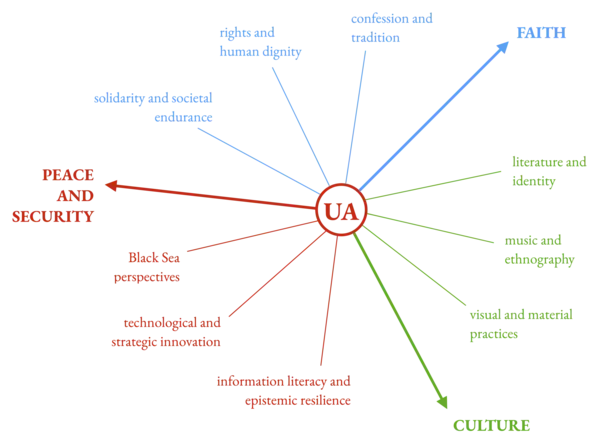
Vectors of activity of the Notre Dame Ukrainian Studies Hub: Culture, Faith, Peace and Security
  • Culture – studying the dynamic artistic and expressive traditions through which Ukrainians—and Crimean Tatars, Ukraine’s indigenous Sunni Muslim people—have forged and defended identities across centuries.

  • Faith – exploring Ukraine’s diverse confessional landscape and the role of religious tradition in enacting solidarity and articulating a defiant vision of human dignity. This realm is too often ignored in the conventional study of international relations.

  • Peace and Security – viewing Ukraine’s geopolitical and geostrategic significance through what Mykhailo Hrushevsky once described as a “Black Sea orientation.” Russia’s war of aggression began with the seizure of Crimea and escalates through Crimea, underscoring how control of the peninsula—and of the wider Black Sea region—remains decisive for questions of sovereignty, global food security, and the architecture of a durable postwar order.

Across these vectors, the Hub demonstrates what a research university can do when scholarship becomes partnership and when knowledge becomes encounter:

  • In the classroom

Shared, experiential learning is our touchstone. Classes in the Ukrainian language and courses in Ukrainian history and culture at Notre Dame draw students from across the University—from engineering and business to theology and the arts. Collaborative Online International Learning (COIL) projects bring Notre Dame and Ukrainian students together in virtual classrooms to study history, culture, religion, and peace. Summer schools and study-abroad programs bring Notre Dame and Ukrainian students together in person in Croatia and Poland to explore questions of recovery, cultural heritage, and faith.

September 26, 2023; Professors Peter Holland and Romana Huk teach ENGL 30591 - Ukraine at War: Representatives of Injustice and Resilience in Ukraine, 2014-2022. The class studies new poetry, digital media and performance writing related to the Russian invasion of Ukraine. The class meets via Zoom simultaneously with one taught in English at the Ukrainian Catholic University (UCU). (Photo by Matt Cashore/University of Notre Dame)
Notre Dame and UCU students and scholars in a COIL classroom (Photo by Matt Cashore/University of Notre Dame)

  • In research

Scholars from Notre Dame and Ukraine join forces through visiting fellowships and joint grant-funded projects to investigate subjects from urban planning to the history of Catholic resistance under communism. Collaborative student research produces permanent resources, including the digital exhibitions Ukrainian Art as Protest and Resilience and Writing the War in Ukraine.

  • In publications

Notre Dame and UCU have collaborated on books including The Trauma of Communism (2022), Resilient Universities (2024), and Facing Russian Aggression: Struggle for Security and Peace in Europe (2025). In partnership with the University of Notre Dame Press, the Hub is also launching a new book series in Ukrainian Studies, edited by Professor Yury Avvakumov, beginning with an English translation of Myroslav Marynovych’s The Ukrainian Idea and Christianity.

  • In the public square

The Hub convenes scholars, students, policymakers, artists, and civic leaders through conferences and policy fora. Film series extend these conversations to wider audiences. Following the inaugural 2025 conference Revolutions of Hope: Resilience and Recovery in Ukraine, the Hub is preparing The Duty of the Good Life: Ukrainian Perspectives on Living on the Edge for March 2027. The Hub is a full member of the Global Coalition for Ukrainian Studies and the driving force behind the new Midwest Alliance for Ukrainian Studies.

  • Into practice

The Hub seeks to bring scholarship into direct, sustained exchange with policymakers, practitioners, civil society leaders, and cultural institutions. Research and teaching shape practice; practice informs research and teaching. In 2026 the Hub convened its first Ukraine Impact Forum in Washington, DC — gathering policymakers and scholars from Notre Dame and UCU to put knowledge to work. Closer to home, the Hub seeks to engage veterans and Notre Dame's award-winning ROTC program, whose experience of service enriches the Hub's peace and security vector.

How It Matters

Ukraine’s rich cultural, religious, and civic traditions reveal how societies find moral resources for resistance and solidarity even when their very existence is threatened.

May 15, 2022; Graduates carry small Ukrainian flags into Notre Dame Stadium before the 2022 Commencement ceremony. The flags were a tribute to Commencement speaker Archbishop Borys Gudziak of Ukrainian Catholic Archeparchy of Philadelphia and former president of Ukrainian Catholic University in Lviv, Ukraine. (Photo by Matt Cashore/University of Notre Dame)
University of Notre Dame Commencement, 2022 (Photo by Matt Cashore/University of Notre Dame)

Ukraine’s fight against aggression and imperialism is a struggle over sovereignty and independence, but also over the future of the very concept of freedom. Its long experience of epistemic and information warfare raises urgent questions about how truth endures in an age of digital disinformation. Its reconstruction asks what it means not only to rebuild infrastructure, but to heal communities and foster trust, care, and hope.

With more than 1,000 Catholic universities and higher-education institutions around the world as potential partners, the Hub aims to expand the global conversation about Ukraine, with particular attention to building intellectual bridges across Latin America, Africa, and Asia – regions where Ukraine remains relatively poorly known, but where its experiences can enrich shared conversations about sovereignty, development, and human dignity.

Studying Ukraine does not ask us to look away from our own world. It helps us see that world more clearly.

This is Why Ukraine.

Ukrainian Studies Hub Members

  1. Yury P. Avvakumov

    Yury Avvakumov

    Associate Professor of Theology

    Yury P. Avvakumov

    Yury Avvakumov

    Associate Professor of Theology

    Papacy and Eastern Churches; scholastic theology; Latin and Byzantine ecclesiology and sacramental theology; Russian and Ukrainian religious thought of the 19th and 20th century

    Website

  2. Head shot of Tobia Boes, professor at Notre Dame. He is wearing a navy suit over a white patterned shirt and brown glasses. He is smiling.

    Tobias Boes

    Professor of German; Chair of the Department of German, Slavic, and Eurasian Studies

    Head shot of Tobia Boes, professor at Notre Dame. He is wearing a navy suit over a white patterned shirt and brown glasses. He is smiling.

    Tobias Boes

    Professor of German; Chair of the Department of German, Slavic, and Eurasian Studies

    • Cultural interactions between Germany and the world
    • Literary modernism
    • Exile studies
    • Contemporary theater
    • Environmental humanities

    Website

  3. David Cortright 200x200

    David Cortright

    Professor Emeritus of the Practice of Peace Studies

    David Cortright 200x200

    David Cortright

    Professor Emeritus of the Practice of Peace Studies

    Nonviolent social change; nuclear disarmament; use of multilateral sanctions and incentives as tools of international peacemaking

    Website

  4. Marianne Cusato, a woman with long brown hair, wearing a dark jacket over a white shirt.

    Marianne Cusato

    Professor of the Practice in Architecture; Director of the Housing & Community Regeneration Initiative

    Marianne Cusato, a woman with long brown hair, wearing a dark jacket over a white shirt.

    Marianne Cusato

    Professor of the Practice in Architecture; Director of the Housing & Community Regeneration Initiative

    Housing solutions for disaster recovery and workforce housing

    Website

  5. Taras Dobko, Visiting Scholar, Ukrainian Catholic University

    Taras Dobko

    Rector, Ukrainian Catholic University

    Taras Dobko, Visiting Scholar, Ukrainian Catholic University

    Taras Dobko

    Rector, Ukrainian Catholic University

    Classical phenomenology and phenomenological epistemology; secularism and secularization in post-modern culture; philosophy of religion; social and philosophical analysis of the concept of rationality in European culture; and homo post-sovieticus in Ukrainian context; university autonomy and academic culture

    Website

  6. A person with shoulder-length hair and a goatee, wearing a black t-shirt, holds a large-lens camera in front of them.

    William Donaruma

    Professor of the Practice, Film Production

    A person with shoulder-length hair and a goatee, wearing a black t-shirt, holds a large-lens camera in front of them.

    William Donaruma

    Professor of the Practice, Film Production

    Documentary and Narrative Filmmaking, color grading, cinematography, camera technology

    Website

  7. Headshot of John Duffy, a man with glasses, a salt-and-pepper goatee, wearing a dark suit jacket, light blue collared shirt, and teal necktie, smiling against a gray background.

    John Duffy

    Professor of English; Faculty Director of the Inspired Leadership Initiative

    Headshot of John Duffy, a man with glasses, a salt-and-pepper goatee, wearing a dark suit jacket, light blue collared shirt, and teal necktie, smiling against a gray background.

    John Duffy

    Professor of English; Faculty Director of the Inspired Leadership Initiative

    Ethics, Rhetoric, Public Speaking, Writing Pedagogy, The 1619 Project

    Website

  8. George Enderle Faculty Fellow 600x

    Georges Enderle

    John T. Ryan Jr. Professor Emeritus of International Business Ethics; Concurrent Professor Emeritus in the Keough School of Global Affairs

    George Enderle Faculty Fellow 600x

    Georges Enderle

    John T. Ryan Jr. Professor Emeritus of International Business Ethics; Concurrent Professor Emeritus in the Keough School of Global Affairs

    Corporate ethics and social responsibility; business and economic ethics; managerial ethical leadership; international issues; business ethics in China

    Website

  9. Vittorio Hosle Faculty Fellow 600x

    Vittorio Hösle

    Paul G. Kimball Professor of Arts and Letters; Professor of German; Concurrent Faculty of Philosophy and Political Science; Founding Director of Notre Dame Institute for Advanced Study

    Vittorio Hosle Faculty Fellow 600x

    Vittorio Hösle

    Paul G. Kimball Professor of Arts and Letters; Professor of German; Concurrent Faculty of Philosophy and Political Science; Founding Director of Notre Dame Institute for Advanced Study

    Philosophy (metaphysics, ethics, political philosophy, aesthetics) and intellectual history

    Website

  10. Romana Huk Faculty Fellow 600x

    Romana Huk

    Professor of English

    Romana Huk Faculty Fellow 600x

    Romana Huk

    Professor of English

    Twentieth-century British literature, postmodern poetries

    Website

  11. Jacob Kildoo

    Jacob Kildoo

    Program Director, Grants and Publications, Nanovic Institute for European Studies

    Jacob Kildoo

    Jacob Kildoo

    Program Director, Grants and Publications, Nanovic Institute for European Studies

    Qur’anic studies and interreligious dialogue

    Website

  12. Khrystyna Kozak

    Khrystyna Kozak

    Master of Global Affairs ’25

    Khrystyna Kozak

    Khrystyna Kozak

    Master of Global Affairs ’25

    Peace studies

    Website

  13. Ian Kuijt Faculty Fellow 600x

    Ian Kuijt

    Professor of Anthropology

    Ian Kuijt Faculty Fellow 600x

    Ian Kuijt

    Professor of Anthropology

    The social geography of village life within small-scale prehistoric and historic period communities, and the material means by which identity and social relations are manifest through human practices

    Website

  14. Reverend James Lies, C.S.C.

    Fr. Jim Lies, C.S.C.

    Senior Advisor for Faculty Fellow Affairs and Partnerships

    Reverend James Lies, C.S.C.

    Fr. Jim Lies, C.S.C.

    Senior Advisor for Faculty Fellow Affairs and Partnerships

    Website

  15. Headshot of Drew Marcantonio, a man with a shaved head, short beard, and light blue collared henley shirt. He is smiling at the camera in a blurred hallway setting.

    Richard "Drew" Marcantonio

    Assistant Professor of Environment, Peace, and Global Affairs

    Headshot of Drew Marcantonio, a man with a shaved head, short beard, and light blue collared henley shirt. He is smiling at the camera in a blurred hallway setting.

    Richard "Drew" Marcantonio

    Assistant Professor of Environment, Peace, and Global Affairs

    Regenerative and durable livelihoods, environmental management and policy, environmental and other violence, and peacebuilding

    Website

  16. A. James McAdams, former director of the Nanovic Institute

    A. James McAdams

    William M. Scholl Professor Emeritus of International Affairs

    A. James McAdams, former director of the Nanovic Institute

    A. James McAdams

    William M. Scholl Professor Emeritus of International Affairs

    European politics and history, particularly populism, communism and post-communism, and far-right extremism

    Website

  17. Headshot of Laura Miller-Graff, a woman with long, light brown hair, smiling warmly against a gray-blue backdrop. She wears a teal top and a beaded necklace.

    Laura Miller-Graff

    Professor and Associate Department Chair of Psychology

    Headshot of Laura Miller-Graff, a woman with long, light brown hair, smiling warmly against a gray-blue backdrop. She wears a teal top and a beaded necklace.

    Laura Miller-Graff

    Professor and Associate Department Chair of Psychology

    Developmental and intergenerational effects of violence, resilience, brief psychological interventions, cross-cultural treatment adaptation

    Website

  18. Mary Ellen O'Connell

    Mary Ellen O'Connell

    Robert & Marion Short Professor of Law; Professor of International Peace Studies

    Mary Ellen O'Connell

    Mary Ellen O'Connell

    Robert & Marion Short Professor of Law; Professor of International Peace Studies

    International law on the use of force, international dispute resolution, and international legal theory

  19. Headshot of Rahul Oka, a person with long, dark hair pulled back, wearing a dark collared shirt. They are looking downward, and their face is partially lit from above, creating a contemplative mood.

    Rahul Oka

    Associate Research Professor of Anthropology

    Headshot of Rahul Oka, a person with long, dark hair pulled back, wearing a dark collared shirt. They are looking downward, and their face is partially lit from above, creating a contemplative mood.

    Rahul Oka

    Associate Research Professor of Anthropology

    Rise/Demise of Urbanism, Ancient Trade and Political Economies, Climate, Conflict, and Migration, Conflict/Refugee Economies, Relief and Development, Modeling of Macroprocess

    Website

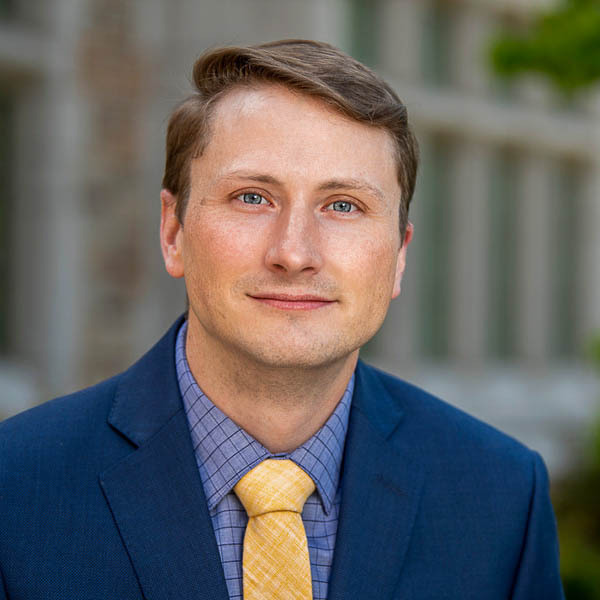
  20. Headshot of Grant Osborn, a man with neatly styled brown hair, blue eyes, and a slight smile. He wears a navy blue suit jacket, a light purple and white checkered dress shirt, and a textured golden yellow tie. A blurred background hints at a stone building with columns and greenery.

    Grant Osborn

    Executive Director, Nanovic Institute for European Studies

    Headshot of Grant Osborn, a man with neatly styled brown hair, blue eyes, and a slight smile. He wears a navy blue suit jacket, a light purple and white checkered dress shirt, and a textured golden yellow tie. A blurred background hints at a stone building with columns and greenery.

    Grant Osborn

    Executive Director, Nanovic Institute for European Studies

    European studies, Ukrainian studies, 19th and 20th-century Irish poetry, the oneiric trope in literature

    Website

  21. Daniel Philpott Faculty Fellow 600x

    Daniel Philpott

    Professor of Political Science

    Daniel Philpott Faculty Fellow 600x

    Daniel Philpott

    Professor of Political Science

    Religion and global politics, Christian political philosophy, transitional justice, reconciliation, ethics and international relations

    Website

  22. A headshot of Stefanos Polyzoide, a faculty member and administrator, wearing a dark suit and patterned tie. He is looking directly at the camera.  The background is blurred and appears to be an interior space with light-colored walls and columns.

    Stefanos Polyzoides

    Francis and Kathleen Rooney Dean of the School of Architecture and Professor of Architecture

    A headshot of Stefanos Polyzoide, a faculty member and administrator, wearing a dark suit and patterned tie. He is looking directly at the camera.  The background is blurred and appears to be an interior space with light-colored walls and columns.

    Stefanos Polyzoides

    Francis and Kathleen Rooney Dean of the School of Architecture and Professor of Architecture

    American domestic architecture; professional practice; residential design; sustainable architecture and urbanism; urban design; Urban design, history, and theory

    Website

  23. Anna Romandash

    Anna Romandash

    Award-Winning Journalist from Ukraine; Master of Global Affairs ’22

    Anna Romandash

    Anna Romandash

    Award-Winning Journalist from Ukraine; Master of Global Affairs ’22

    Journalism; human rights and media

    Website

  24. Zoriana Rybchynska

    Zoriana Rybchynska

    Head of the Cultural Studies Department, Ukrainian Catholic University

    Zoriana Rybchynska

    Zoriana Rybchynska

    Head of the Cultural Studies Department, Ukrainian Catholic University

    cultural memory and reinterpretation of heritage; cultural mechanisms of creation and development of local communities; phenomenon of the cultural landscape

    Website

  25. Clemens Sedmak

    Clemens Sedmak

    Director of the Nanovic Institute for European Studies; Professor of Social Ethics

    Clemens Sedmak

    Clemens Sedmak

    Director of the Nanovic Institute for European Studies; Professor of Social Ethics

    Catholic social tradition, social ethics, poverty studies, migration and refugee studies, theories of dignity and justice, epistemology and ethics, philosophy of religion and religious studies

    Website

  26. Annie Seul (Photo by Peter Ringenberg/University of Notre Dame)

    Annie Seul

    Program Manager of Finance and Administration, Nanovic Institute for European Studies

    Annie Seul (Photo by Peter Ringenberg/University of Notre Dame)

    Annie Seul

    Program Manager of Finance and Administration, Nanovic Institute for European Studies

    French, the intersection of literature and medicine in 18th-century France, emphasizing literary representations of suffering and its salutary effects

    Website

  27. Tetyana Shlikhar

    Tetyana Shlikhar

    Assistant Teaching Professor of Russian; Director of Undergraduate Studies in Russian

    Tetyana Shlikhar

    Tetyana Shlikhar

    Assistant Teaching Professor of Russian; Director of Undergraduate Studies in Russian

    Research interests include, 20th and 21st century Russian literature, cinema, and culture, memory studies, film studies, Russian language pedagogy, second language acquisition, and curriculum planning and assessment.

    Website

  28. Headshot of Ernesto Verdeja, a man with short brown hair and glasses. He wears a dark gray blazer over a purple pinstriped shirt and smiles slightly. The background is blurred and appears to be the interior of a building with light-colored walls.

    Ernesto Verdeja

    Associate Professor of Peace Studies

    Headshot of Ernesto Verdeja, a man with short brown hair and glasses. He wears a dark gray blazer over a purple pinstriped shirt and smiles slightly. The background is blurred and appears to be the interior of a building with light-colored walls.

    Ernesto Verdeja

    Associate Professor of Peace Studies

    Genocide and mass atrocities; political reconciliation; new technologies and violence early warning; critical theory

    Website

  29. Andrii Yasinovskyi

    Andrii Yasinovskyi

    Dean of Humanities, Ukrainian Catholic University

    Andrii Yasinovskyi

    Andrii Yasinovskyi

    Dean of Humanities, Ukrainian Catholic University

    Early modern religious culture, Byzantine studies, classical philology, and antique tradition