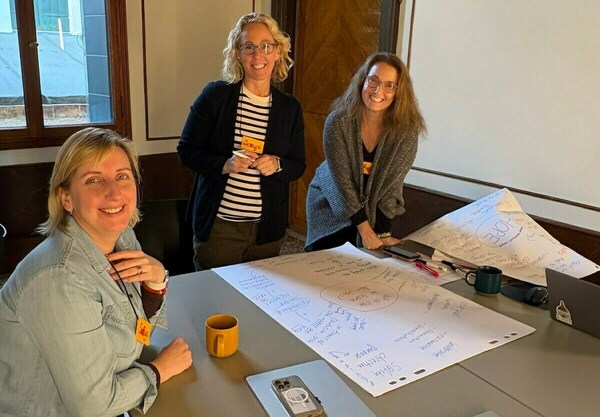
Authors’ Note: The authors made a thoughtful and considered decision to write this piece using the first person, even though only one of the three authors is Ukrainian and lives and works in situ. Some of the experiences described here are drawn from the direct experience of one author; the interpretation and position are shared by all three. We note that Sofiya Opatska lives in Ukraine, serving as the vice-rector of strategic development at Ukrainian Catholic University (UCU) in Lviv. Amy Kenworthy has a formal position as a visiting professor at UCU and was in Lviv at the time of this writing. Jessica McManus Warnell is a faculty member at the University of Notre Dame. Sofiya, Amy, and Jessica are engaged in ongoing research on the topic of business educator and practitioner hope amid crisis.
As we approach four years of the full-scale invasion of Russia into Ukraine, we would like to reflect on what it means to be an educator living and working in a country experiencing violent conflict every day.
The invasion is causing a massive humanitarian crisis. Often in international news, we see the question being asked: Do Ukrainians want peace? Of course. It is what drives resilience and feeds hope. Every single day, Ukrainians live within an unpredictable and unknown environment with constant attacks on both civilians and the infrastructure that provides basic needs.

As an example, which took place as we were working on this essay, on January 8th, 2026, many universities in Kyiv had to make quick morning decisions to completely switch to online teaching. They had to ask their students to leave Kyiv and go home due to the overnight destruction of critical infrastructure by Russia, which left most of the city (including students’ dormitories) without water, electricity, and heat. In January, in Ukraine, temperatures average well below zero. Although huge efforts are put into repairing systems quickly and efficiently, life is not possible without heat and water, so once again, the lives of Ukrainians are disrupted in dangerous ways.
Here, we feel that it is important to note that the Russian targeting, destruction, and resultant damage to educational infrastructure occur systematically, regardless of the territory of active hostilities. To date, from the start of Russia’s full-scale invasion of Ukraine in February 2022, a total of 4,048 educational institutions in Ukraine have been affected by bombing and shelling, and 408 of them have been completely destroyed.
... although there is no idea what each new day will bring, the role, responsibilities, and all associated activities of the University must be focused on learning and growth for decades, and perhaps also centuries, to come.
According to the World Bank, the war continues to have profound physical, psychological, social, economic, and environmental impacts, which will be felt for generations to come. In these horrific conditions, thousands of educators continue to teach both online and in situ on campuses (depending on where the institution is located) as education is recognized as an institution critical to managing the future of the country. Ukrainians must, and will, keep our universities running. This is especially important in a country where one cannot imagine what each day and night will bring with it. So many of the nights in Ukraine are disrupted, often for hours on end, with air raid alarms due to missile and drone attacks. While developing a strategic plan at the Ukrainian Catholic University (UCU) in 2023, the management team realized that although there is no idea what each new day will bring, the role, responsibilities, and all associated activities of the University must be focused on learning and growth for decades, and perhaps also centuries, to come.
During the summer of 2025, our team, Sofiya Opatska (UCU), Jessica McManus Warnell (University of Notre Dame), and Amy Kenworthy (Bond University in Australia and UCU Business School), interviewed 16 faculty members teaching at UCU Business School. We were interested in learning their perspectives on the role of hope for themselves, their students, and for Ukraine’s future in an environment rife with uncertainty and destruction.

It is important to note that the majority of the educators who were interviewed have senior positions in business organizations or came to education from industry to combine teaching with business management roles in education. Their choice to teach in such difficult times is a conscious commitment to supporting the next generation and the future of Ukraine.
As one of the faculty members and director of M.Sc. in Marketing Management program, Igor Blystiv, shared:
I remember the first meeting with a group of students in 2022. It was around one month after the start of the invasion. I said to them: “If we choose to stay in Ukraine (as people, as company representatives), we need to create value, we need to organize more socially responsible projects. So let's try to think what we can do in five minutes, in one hour, in one day, in one week, or even in one year.” I also said marketing is still here, and we need to care about our clients, about our customers, about each other. So let's try to do this, and please try to find some routines, because it brings perspective that tomorrow will be the same and will make you feel fine. It was a very timely conversation, as after class some of the students came to me and said: it was very important to us to hear that everything can be fine, we can stay here and we can do what we can to help our companies, our clients, and our country.
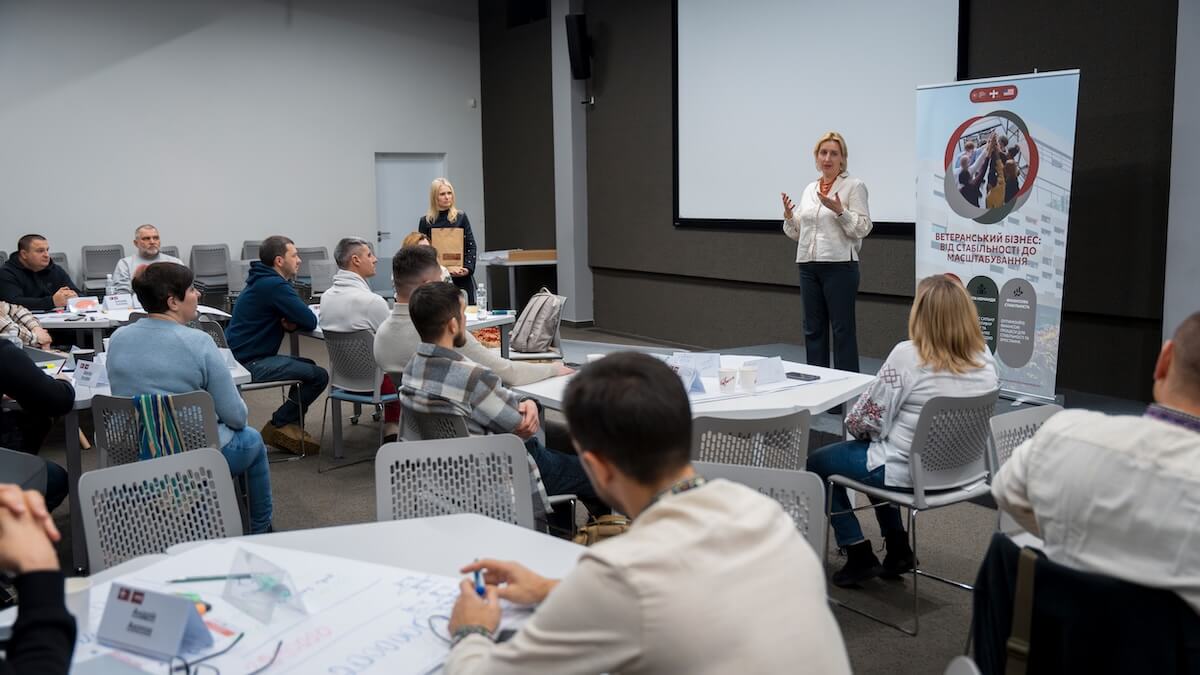
This small interaction between faculty and students in a time of crisis shows the complex and multifaceted roles educators have right now in Ukraine. Some of the activities the faculty we spoke with find themselves engaging in regularly include:
-
Talking to students about recent events related to the attacks and other geopolitical movements in the world (these discussions range in terms of temporal focus from an attack the night before to the four years since the full-scale invasion began);
-
Focusing on purpose—how we can help our country and what roles we can each play in that movement;
-
Sharing vulnerably and transparently about the challenges of maintaining a healthy mental and physical state and, relatedly, how we can practice self-care;
-
Role modeling the importance of having a basic structure for each day and the small wins that those simple structures provide;
-
Bringing normality and a sense of safety to students’ environments; and
-
Creating spaces for care and connection for students so that they know they are members of a unified community—this helps them to continue through the chaos and, even in small ways, to make some sense of nonsense.

The typical job description for university educators will not include most of the above. At UCU, formal roles do not include these things either. Yet, we live in a world in which these responsibilities have moved to the forefront of who we are and what we do. Indeed, the situation in Ukraine begs the question of how much traditional job descriptions accurately reflect the most important parts of what we as educators do. In different ways and within different types of crises (e.g., health, financial, geopolitical, environmental, social, war), we will each be asked to respond to students’ changing social, psychological, and physical needs in a highly fragmented and volatile world.
In an example of what another UCU educator, Iryna Tymoshchenko-Petrova, who teaches organizational behavior and human resource management, shared:
With every topic, I try to contextualise it—the topic and the war. If I’m teaching about motivation, then it’s motivation during the war; if it’s strategy, then it’s strategy during the war. Every time I teach, I try not to have illusions, but share reality and hope students will not have illusions. I try to show a clear situation—a real situation, because in a real situation, we have facts and we can change something.
"I have to be honest with myself that whatever I teach them, it matters, and it's worth investing their minds now. Every lecture for me is like mentorship."
Exploring how educators are adapting within war, at UCU, we understand that teaching in Ukraine is also a huge responsibility in terms of the pressure and high expectations students have for themselves as they determine their roles in building Ukraine’s future. Ivan Petrenko, the UCU Director of Ideas Center and educator in the area of entrepreneurship, illustrates this through this reflection:
The best thing to describe teaching here is not just sharing facts and providing information to the students, but giving them meaning of their time—chaos in war, talking to them about resilience, about dignity. So things that would help them understand that studying at university, not just to get their diploma, but to become someone bigger and to help rebuild Ukraine, because they're choosing to stay in the country. And I have to be honest with myself that whatever I teach them, it matters, and it's worth investing their minds now. Every lecture for me is like mentorship.

Unlike previous decades, many young people today, especially in Ukraine, have little idea what their future might look like. As Catholic university communities, both UCU and Notre Dame have a longstanding practice of working to nurture the concept of Integral Human Development into everything we do. Integral Human Development (IHD) is a holistic approach to human flourishing which emphasizes the development of the whole person (economically, socially, culturally, politically, and spiritually), promoting their dignity, equality, and the common good in a just community, thus moving beyond a focus on material wealth to one that is centered upon spiritual and relational well-being. The IHD concept was chosen by our two institutions to serve the growth and development of students, with the aim of creating an educational environment in which students are nurtured and supported to become not only better professionals but flourishing human beings.
Returning to what it is like teaching within war in Ukraine, on one hand, war has little to do with humanistic attributes of character, though it highlights the clear need for humans to engage and connect in ways that require having hope. Yet Ukrainians live in a place and time where no one knows what each day will bring. Rationally, given how long the invasion has continued and the fact that there is no end in sight, Ukrainians should be feeling relatively hopeless. Our interviews showed that for educators at UCU, hope has a very special meaning of action, not one of wishful expectation.
As Volodymyr Turchynovsky recently wrote in a blog: For Ukrainians, hope serves. It cooks, shelters, teaches, rebuilds, and fights. It is the moral energy of a society that refuses to give up on its own humanity.
Roksolyana Voronovska, who teaches in the area of strategy and business design, clearly defined this contextualization for us:
Hope is action. The idea is that you have an action and something tied to the action. The words in Ukrainian are ‘Na Dia’, and Dia means action. Hope must include action. You quickly realize when living within war that the romantic ideal of hope doesn’t exist. Without effort and critical thinking, there is no hope.

In the context of education, Olena Kuzmichova, who teaches crisis management, shared so beautifully,
Things give you hope when you know the next piece is reachable. Here, at UCU as we teach while living in war, hope is creating community, building something, and making a change… and we strive to make little changes every day because they are all little successes tied to hope.
As the above reflections indicate, for those who are living and teaching within war, hope needs rethinking. Ukrainian educators have to keep moving forward, doing things, achieving small wins, working together, creating community, supporting students and each other as well as those who fight so bravely and are rising and giving their lives for freedom. The educators we spoke with keep moving forward every day, not because it is easy. It is not. It is their choice to keep moving forward for their country, people, language, history, culture, and children’s futures. As Oleksandra Alkhimovych, who teaches human resource management and leadership, evocatively shared,
Hope gives us the courage to make decisions despite fear, despite uncertainty. No one will believe a leader who does not have hope. I believe hope has three parts: it is a goal, it is planning, and it is the motivation to believe in yourself and follow through on your plans. For me, hope is the inner mission that activates planning.
"... hope is creating community, building something, and making a change … and we strive to make little changes every day because they are all little successes tied to hope.... Hope gives us the courage to make decisions despite fear, despite uncertainty."
We have been moved by the vulnerable insights and shared reflections of the educators who spoke with us, as we hope you will also. We use the word hope here intentionally and view our writing as the action that we believe will encourage action on the part of those who read this to enact hope through doing. Ideally, some of that will be in the direction of connecting with, supporting, sharing about, and partnering with colleagues at UCU.
Ukrainians are calling out to be seen and heard, and are grateful for those who continue to engage. As an example, for faculty who teach with cases, we have three published cases about Ukrainian leaders and how they are navigating the process of running a business in ways that are achieving significant social impact during the war. Each case has a clear connection to the IHD ethos and was written to serve as a catalyst for discussion about the role of motivation, connection, community, and hope. One is about purpose and passion as keys to leadership within war, another is about social entrepreneurship and effectuation, and the third is about the necessity of pivoting when confronted with crisis. Each is available through Ivey’s online catalog, and the royalties from each case go directly to support charities in Ukraine.

We would like to conclude this essay with a comment from Oleg Chaharyn, an instructor of finance and data analytics, who shared,
"Hope is action.... You quickly realize when living within war that the romantic ideal of hope doesn’t exist. Without effort and critical thinking, there is no hope."
I like Vaclav Havel’s (the first President of the Czech Republic) definition that hope is not an understanding that everything will turn out the way you want, but instead it is a belief that you are doing the right thing. We usually do not think about hope when everything is okay; rather, we turn to it when things are not okay. Out of the three—faith, hope, and love—hope is usually thought about the least. It can be seen as small comparatively. But as it turns out, this small piece—hope—can give you everything.
The research project “Hope in Action: Exploring Ukrainian Educators’ Understanding, Cultivation, and Enactment of Hope Within War” is supported by the Nanovic Institute for European Studies, Keough School of Global Affairs.