Frozen in Time: How Interactive Exhibits Shape Individual Climate Responsibility
Monay Licata

It is no secret that climate change is upon us, though many choose to disregard the harmful effects and continue exploiting nature. The truth is, the climate crisis is ongoing and urgent, calling for action now. However, when attempting to create change, we often ask ourselves, “What can I alone do to help a large problem like climate change?” The lack of a prepared response to this question creates a feeling of hopelessness which leads to inaction. With this, we convince ourselves that the only solution must come from large corporations or international organizations who have the time and resources to make meaningful change. Though it is true that some of these organizations work tirelessly to improve the apocalyptic state our climate seems to be in, it is more important than ever to take individual responsibility when it comes to climate change.
Climate change is a strange subject in that it is both abstract and tangible: it is too big to fully grasp, yet we feel its effects every day. On one hand, the abstractness of climate change allows for people to approach it with unique and powerful perspectives. Abstract climate perspectives allow individuals to add to the climate narrative in their own way and make sense of climate change as it seems necessary and possible to them. This allows them to take ownership of their understanding of the topic and possibly feel more in control. On the other hand, there is the more tangible issue: the more we see it around us, the more it impacts us, and the less abstract climate change is, the more we have to acknowledge that it is destroying our beautiful world. This is supported by authors Van Langue and Huckelba, who note that “one of the chief issues regarding climate change is its abstractness: consequences for the collective in the long-term are much more abstract than consequences for the self in the here-and-now” (Van Langue and Heckelba, 2021). Further, according to Maya Lin—an American architect, designer, and sculptor focusing on climate change issues—“If it stays abstract, how do you get people to connect with nature?” (Climate Artists, 2024). This connection with nature is necessary for individual buy-in and ultimately a positive response to climate change. Therefore, the role of stories and interactive art exhibits on climate change is vital to changing the story of the climate apocalypse narrative.
Through this exploration of the climate apocalypse, I will analyze the role of interactive exhibits and the power of stories through the man-made Ice Cave exhibit at the Perlan Museum in Reykjavik, Iceland. Here, stories and interactive exhibits play a crucial role in influencing individual behavior and fostering climate responsibility by bridging the gap between awareness and action through emotional engagement. Whether through storytelling, interactive engagement, or reflective participation, experiences in the Perlan Ice Cave exhibit cultivate a sense of urgency and agency, reminding us that the future is not predetermined—it is being written by our choices today.
Role of the Individual in Climate responsibility:
As individuals, we make choices every day about how to consume, reuse, and dispose of goods. As consumers, we are responsible for considering how these goods and services help or harm our environment and making changes to our habits. However, as most of us have experienced, this consideration often throws us into a downward spiral of existential dread as it seems like nothing we do as an individual actor matters to the larger problem of climate change. This shifts action to the collective, allowing individuals to forfeit their responsibility in this global climate crisis. Steven Cohen, author of The Role of Individual Responsibility in the Transition to Environmental Sustainability, says that some see “the fixation on individual responsibility is a distraction from the more important task of compelling government and major institutions to implement systemic change” (Cohen, 2021). Anders Leverman of the Potsdam Institute for Climate Impact Research posits a similar philosophy. According to Levermann:
Personal sacrifice alone cannot be the solution to tackling the climate crisis. There’s no other area in which the individual is held so responsible for what’s going wrong. And it’s true: people drive too much, eat too much meat, and fly too often. But reaching zero emissions requires very fundamental changes. Individual sacrifice alone will not bring us to zero. It can be achieved only by real structural change; by a new industrial revolution. Looking for solutions to the climate crisis in individual responsibilities and actions risks obstructing this. It suggests that all we have to do is pull ourselves together over the next 30 years and save energy, walk, skip holidays abroad, and simply ‘do without.’ But these demands for individual action paralyse people, thereby preventing the large-scale change we so urgently need.
Perhaps Levermann is right, but surely there is another way. What if, according to Cohen, “individual responsibility and the thought process and value shift that stimulates individual action [is] the foundation of the social learning process required for effective collective action” (Cohen, 2021)? One such aspect of the individual learning process includes interactive art exhibits that invite individuals to personally engage with the beauty of the earth and the destructive forces of climate change. Experiencing and engaging with art transforms abstract concerns into tangible emotions and actions. Interactive exhibits, in particular, bridge the gap between awareness and responsibility, immersing individuals in the urgency of climate change and compelling them to act.
Perlan Ice Cave

Ice caves are natural formations that develop within glaciers during winter as meltwater streams carve intricate pathways through the ice. At the Perlan Museum in Reykjavik, Iceland, visitors can experience a unique opportunity to walk through and interact with a meticulously constructed artificial ice cave. This 100-meter-long exhibit build in the basement of the museum, crafted from 250 tons of snow sourced from Icelandic mountains, allows guests to engage with the cave's intricate grooves, peer through ice caverns, touch glacier stones, observe sediment deposits from ancient volcanic eruptions, and even sit upon a throne made entirely of ice (Perlan Museum, 2025). This immersive experience transforms the abstract concept of glacial formations into a tangible reality, enabling individuals to explore one of Earth's natural wonders without venturing deep into the Icelandic wilderness.

Figure peering into the ice cavern below. Photo by Monay Licata.
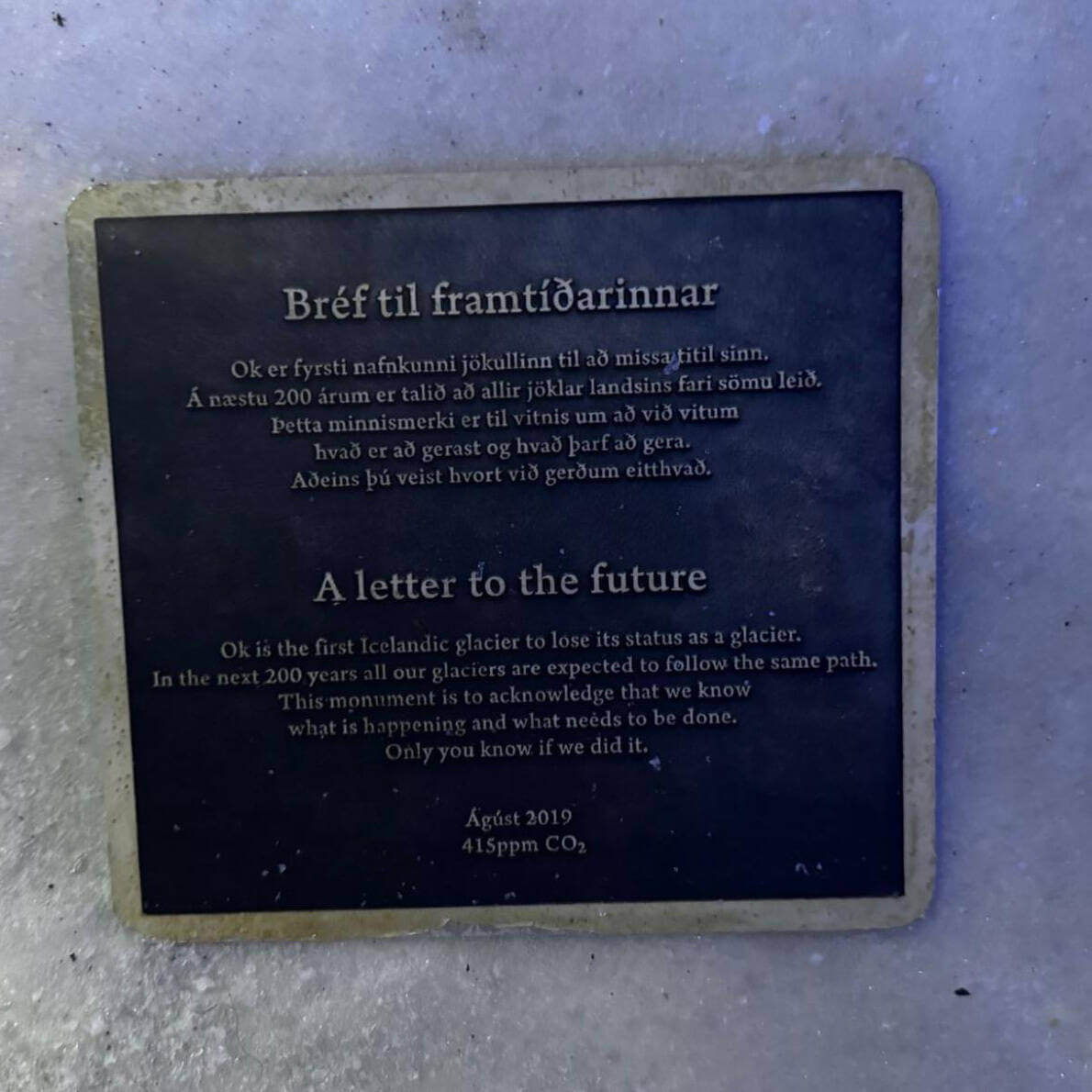
Beyond its enchanting allure, the glacier cave exhibit serves as a poignant reminder of the precarious future facing glaciers and ice formations as climate change continues to threaten these icy landscapes. A bronze plaque within the cave, titled "A Letter to the Future," solemnly notes:
“Ok [Icelandic: Okjökull] is the first Icelandic glacier to lose its status as a glacier. In the next 200 years all our glaciers are expected to follow the same path. This monument is to acknowledge that we know what is happening and what needs to be done. Only you know if we did it.”
This message directly appeals to each visitor individually, posing the implicit question: Are you willing to take the necessary actions to protect our glaciers? While a span of 200 years may seem distant, this call to action shows that contemporary actions will have far-reaching consequences (for good or ill). Regardless, the urgency of the situation demands immediate attention. The concept of time plays a crucial role in the climate apocalyptic narrative, shaping how individuals and societies perceive the urgency, inevitability, and consequences of environmental collapse. Some apocalyptic narratives depict sudden and catastrophic ends or transitions into new stages of being, whereas here, the climate apocalypse unfolds gradually, making it both elusive and deeply unsettling. Foust and Murphy add to this theme by stating “although the apocalyptic climate change narrative usually follows the same basic plot of catastrophe, the treatment of time and agency can be quite variable. There are distinct differences in the certainty of endpoints across different narratives, with some narrators implying that ‘the end’ is happening now, and others suggesting that ‘the end’ will happen at some known or hypothetical point in time” (Foust & Murphy, 2009). The conflicting apocalyptic natures of time as it relates to climate change creates a paradox—while we are constantly warned about the looming disaster, its incremental progression allows for denial, procrastination, and inaction.
Anders Levermann, who has written extensively on the irreversibility of climate tipping points, emphasizes that the time we have to act is far shorter than we perceive. He warns that delaying action now will lock in catastrophic changes that will be impossible to undo. Once we cross certain thresholds, there is no going back. Leverman states that “recent satellite observations have confirmed the accuracy of two independent computer simulations that show that the West Antarctic ice sheet has now entered a state of unstoppable collapse where the planet has entered a new era of irreversible consequences from climate change. The only question now is whether we will do enough to prevent similar developments elsewhere” (Levermann, 2014). Through his scholarship and documentation on ice sheets around the world, Levermann’s work further highlights the idea that climate apocalyptic narratives should not just focus on a distant, impending collapse but also on the decisions being made in the present that shape irreversible outcomes.
Time is a central concept through the dynamic nature of the ice cave—its subtle creaks and the chilly airflow—immerses visitors in an environment that mirrors a real glacier, fostering a personal connection to the pressing issue of climate change. The ice cave is ever-changing and actively melts around visitors as it would in the wilderness. However, the Perlan ice cave is artificially cooled by an AC unit—a luxury natural ice caves do not have—preserving its form. The use of AC creates tension between medium and meaning where the ice cave must use the AC to preserve itself, but in preserving itself it is also using energy which contributes to the very issue it seeks to remedy. However, it is crucial as it draws in visitors. This aligns with Steven Cohen's perspective that individual experiences are crucial in transforming abstract concerns into concrete actions.
The Ice Throne
While wandering through the cave, all visitors must pass by a large life-like throne made out of ice before exiting the exhibit. However, the inclusion of the ice throne in the cave introduces a complex narrative. On one hand, inviting visitors to sit upon the throne personalizes the experience, potentially fostering a deeper connection to the exhibit's message. This is supported by scholar Ingar Brinck, who states that aesthetic experience and engagement with pieces of art “cause the viewer to bodily and emotionally move with and be moved by individual works of art, and consequently to recognize another psychological orientation than her own, which explains how art can cause feelings of insight or awe and disclose aspects of life that are unfamiliar or novel to the viewer” (Brinck, 2017). On the other hand, this act may inadvertently convey an anthropocentric view, suggesting human dominion over nature, which could undermine the exhibit's conservationist intent. This duality raises the question: Does this interactive element enhance the storytelling necessary to promote glacier preservation, or does it diminish the gravity of the message? In fact, to Cohen’s point of bringing themes out of the abstract, this seems like a successful way to invite individuals to make this experience their own, as if to connect with the ice cave and its message. However, sitting on a throne of ice suggests a counterproductive narrative. The ice cave is trying to preserve the natural environment and encourage individuals to live in harmony with nature. This idea is interrupted by the anthropocentric element of the ice throne, which seems to elevate humanity above nature. By inviting guests to sit on an ice throne, the preservative message of the cave is partially diminished, reducing the severity of the call to save the glaciers. Despite this complicated narrative, is this invitation to intimately interact with the ice throne necessary to “sell the story” of glacier preservation? The throne successfully encourages visitors to take pictures, spend more time in the cave, and share their unique experience with others. This individual experience then creates an impression on other individuals, encouraging them to visit the exhibit and museum. However, this also raises the issue of international travel to Iceland which adds to the very thing that destroys these natural arctic features in the first place.
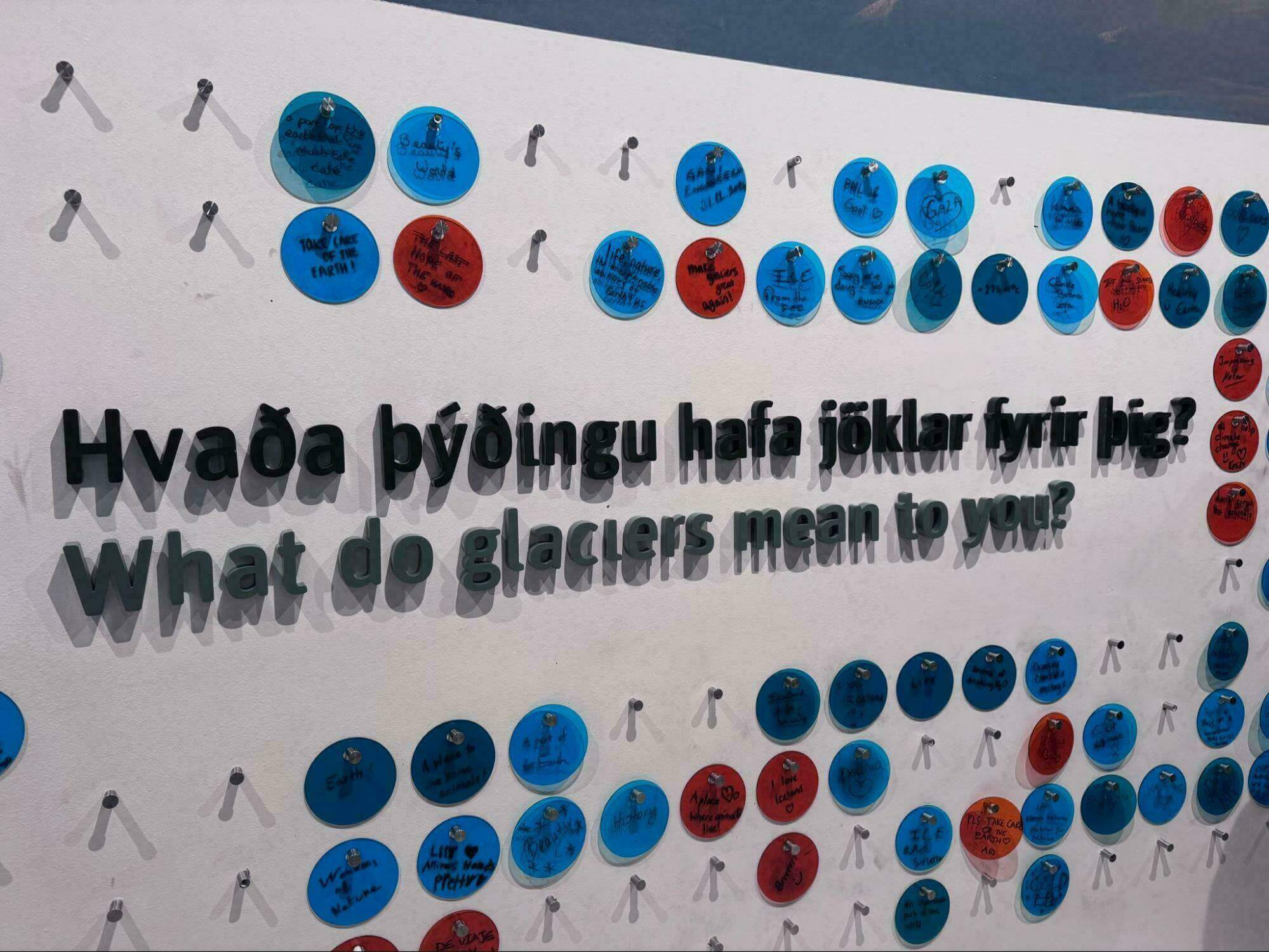
Upon exiting the ice cave, visitors encounter a glacier exhibit featuring a wall titled “What do glaciers mean to you?” This interactive display encourages individuals to reflect on their personal experiences and share their thoughts, effectively empowering them to contribute to the ongoing narrative about our planet's future; they become part of the exhibit. This participatory element embodies Cohen's assertion that individual engagement is vital in addressing global environmental challenges.
Conclusion
The Perlan Ice Cave exhibit exemplifies the power of interactive exhibits and storytelling in bridging the gap between abstract climate awareness and tangible emotional engagement. Through immersive experiences, visitors are transported from passive observers to active participants in the unfolding climate crisis, compelled to confront both the beauty and fragility of our planet. Levermann underscores that the time for action is not in some distant future but now—before irreversible tipping points are crossed. With this, it is crucial that individuals claim their responsibility in shaping this narrative as Cohen’s own work also attests. While large-scale systemic change is necessary, the role of individual experience and responsibility cannot be dismissed. Further, tension exists between the abstract and tangible narratives of climate change, making it harder to grasp. However, by fostering deep personal connections to climate narratives, exhibits like the Perlan Ice Cave empower individuals to recognize their place within this global crisis. In addition, tensions exist between medium and meaning which is manifested through the presence of the AC unit and the ice throne, challenging visitors to decide whether the climatic impact of the unit, and the experiential aspect of the throne, is a necessary tradeoff for the educational benefits of the cave. Whether through interactive engagement or reflective participation, these experiences cultivate a sense of urgency and agency, reminding us that the future is not predetermined—it is being written by our choices today.
Works Cited
- Lin, Maya. Climate Artists. WNET group. 2024. Retrieved from https://www.allarts.org/programs/climate-artists/?utm_source=google&utm_medium=traffic&utm_campaign=climateartists&gad_source=1&gclid=Cj0KCQiAsOq6BhDuARIsAGQ4-zhpaLuQU4VCe8cwA2lRKnZEvvXjD1Rmcc3722zpWHXbfb4X9BIC-YsaAqgmEALw_wcB
- Paul A.M. Van Lange; Anna L. Huckelba. Psychological distance: How to make climate change less abstract and closer to the self. Science Direct. 2021. Retrieved from https://www.sciencedirect.com/science/article/pii/S2352250X21000373
- Cohen, Stephen. The Role of Individual Responsibility in the Transition to Environmental Sustainabiliy. Columbia Climate School. 2021. Retrieved from https://news.climate.columbia.edu/2021/05/10/the-role-of-individual-responsibility-in-the-transition-to-environmental-sustainability/
- Perlan Museum. Ice Cave and Glacier Exhibition: Learn about Iceland’s glaciers and their bleak future. 2025. Retrieved from https://perlan.is/exhibitions/icecave
- Foust, Christina; Murphy, O’Shannon William. Revealing and Reframing Apocalyptic Tragedy in Global Warming Discourse. Taylor & Francis. 2009. Retrieved from https://www.tandfonline.com/doi/full/10.1080/17524030902916624
- Levermann, Anders. How Antarctica shows we’re at the point of no return. World Economic Forum. 2014. Retrieved from https://www.weforum.org/stories/2014/07/antarctica-sea-levels-greenhouse-gas-energy/
- Brinck, Ingar. Empathy, engagement, entrainment: the interaction dynamics of aesthetic experience. National Library of Medicine. 2017. Retrieved from https://pmc.ncbi.nlm.nih.gov/articles/PMC5976699/
Author Biography
Monay Licata is a senior studying honors marketing and global affairs. With special interests in sustainability, Integral Human Development, and consumer behavior, she has excitedly jumped into a number of unique research projects throughout her time at Notre Dame. For instance, last spring, Monay had the opportunity to write a piece for the Nanovic institute titled “Search for Safety: Refugees Blinded from European Society” as part of the Fighting for Democracy and Human Rights through the arts exhibition. In addition, she wrote her senior capstone on Differentiation in Emerging Markets, focusing on small businesses in Kampala, Uganda. In her last semester at Notre Dame, Monay is excited to share insights from her last research project titled “From Awareness to Action: The Role of Interactive Exhibits in Climate Responsibility” focused on climate apocalypse and the importance of individual action in driving climate awareness and responsibility.
Back to the exhibition home page