
Belarus 2020 and Belarusian Connections
Pasha Kritchko
Injustice and Beauty in Belarusian Resistance
By: Annie Rehill ’24
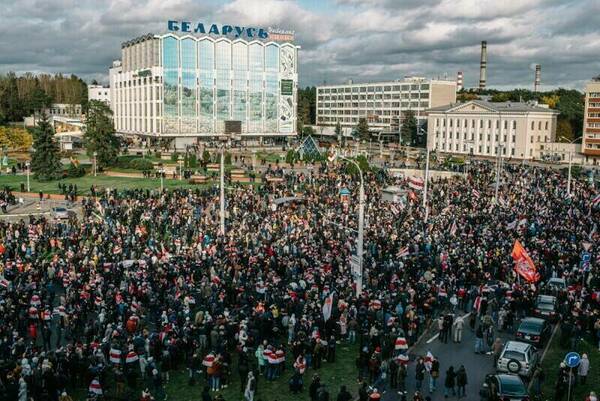
In August 2020, Belarus witnessed a critical moment in its history and, more broadly, in the trend of democratic backsliding across Eastern Europe. Tens of thousands of Belarusians took to the streets in peaceful protests against President Lukashenko’s declared re-election victory, which independent observers disputed. When protesters demanded a new free election and Lukashenko’s resignation, the regime cracked down harshly, detaining hundreds and committing human rights abuses. Photographer Pasha Kritchko captured this pivotal moment. Initially working as a wedding photographer, Kritchko began covering the political situation in his country around the time of the 2020 elections. His photographs capture the duality of Belarus’s situation; his “Belarus 2020” collection depicts the inspiring spirit of the protests, while his 2023 “Belarusian Connections” collection shows the dark aftermath of the protests and the resilience Belarusians must now demonstrate both at home and abroad.
Taken during the 2020 protests, Kritcho’s photographs depicted the diverse multitudes of protesters–young and old, men and women, clergy and civilians. The moving photographs show them united and sharing in the joyful aspects of celebrating Belarusian national identity: flying their flag, playing music together, and dancing in the streets.

This photograph of a woman offering a police officer a carnation invokes the image of the bloodless 1974 Portuguese Carnation Revolution, reflecting the protesters’ hope that Lukashenko would peacefully step down like the Portuguese Estado Novo government. This emphasis on peace and solidarity to create a better political system for themselves and future generations is a key theme of the collection. While conveying the population’s rage at the injustices of the government and their determination to have their voices heard, the photos also promise that those who believe in Belarusian democracy will continue to work for it from afar, even as they are forced into exile by Lukashenko’s government.
While Kritchko’s “Belarus 2020” collection captured the spirit and determination of the 2020 protesters, the harsh crackdown by Lukashenko’s regime forced many dissidents and journalists, including Kritchko himself, into exile. His subsequent work in the “Belarusian Connections” collection–which won the Belarus category of the EU Neighbors East photo contest in January 2023–poignantly documents the experiences of this Belarusian diaspora scattered across neighboring countries, particularly in Ukraine, Poland, and Lithuania. As Belarus descends further into authoritarianism, this diaspora struggles to maintain its national identity and democratic aspirations for Belarus.
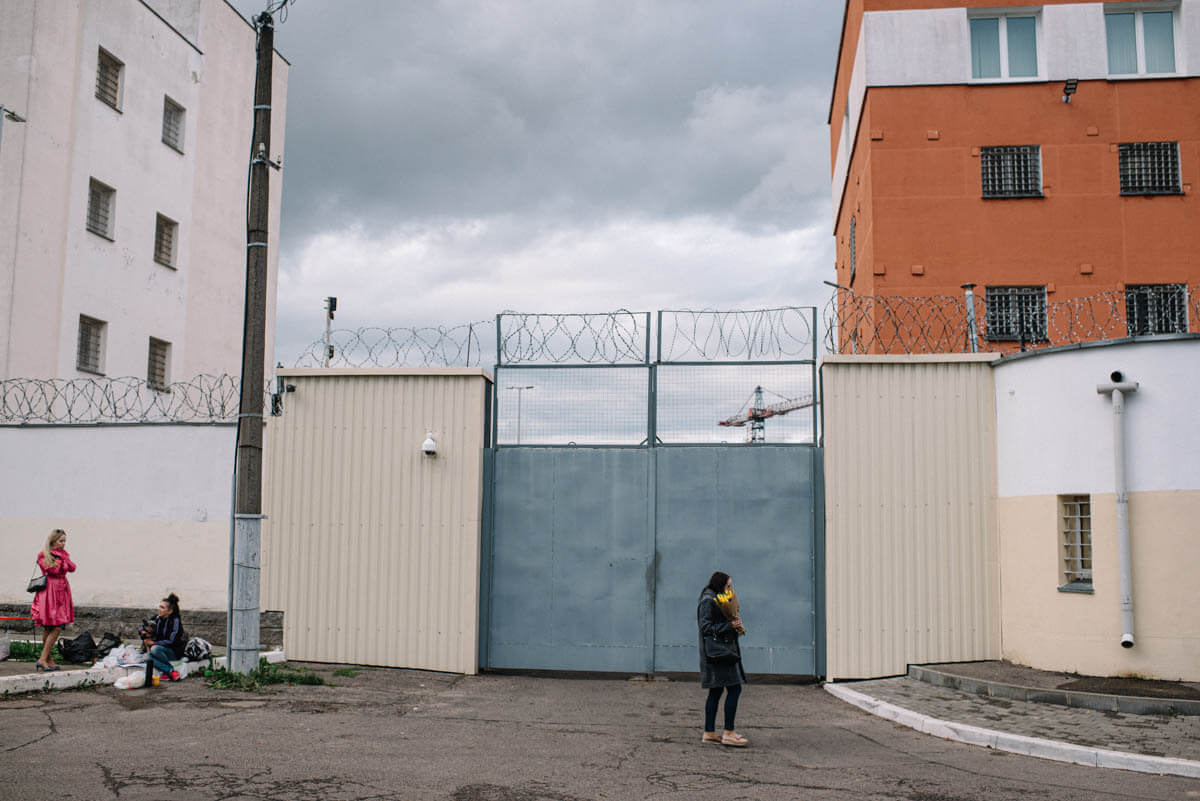
One haunting photograph depicts a woman waiting outside the Okrestina detention center in Minsk, where Belarusian opposition activists were held and abused after arrests during the 2020 protests. The depiction of the prison itself is a powerful commentary on the regime’s undemocratic practice of arbitrarily detaining and abusing peaceful protesters. Beyond that, it encapsulates the estrangement and separation inflicted on Belarusian families by the brutal crackdown, with loved ones torn apart by imprisonment and exile. The way the subject waits at the door, hoping for the safety of her loved one inside the prison, can also symbolize the plight of Belarusian refugees abroad, who can only look upon their homeland from the gates, cut off from their roots and unable to stay in reliable contact with those left behind. In his description of the collection, Kritchko wrote:
“We have become used to seeing our relatives once a year unless we were lucky and they were able to travel with us or get a visa. For some, there is no such possibility, because mom or dad or someone close is in prison. We send letters that do not always arrive, and in special cases get to make video calls a few times a year. We are watching from the outside how conditions are worsening for some of the political prisoners, how their health is deteriorating. It has become natural for someone in the family to die, and not be able to go home to the funeral.”
Deprived of that physical connection to Belarus, the exiled diaspora must find alternative ways to maintain their Belarusian bonds and identity. For many artists and journalists, creative work serves not only to raise global awareness but also to grapple with the profound sense of alienation from their homeland.

Kritchko’s “Belarusian Connections” collection also highlights the interconnections between Belarus’s pro-democracy movement and the fight for Ukrainian sovereignty. Since the 2020 election protests, Lukashenko has allied more closely with Putin and allowed Russian forces to use Belarus as a launchpad for attacks on Kyiv. The war worries pro-democracy Belarusians because it heralds the possibility of a similar incursion into Belarusian territory. Moreover, many Belarusians in exile found refuge in Ukraine after 2020, making the attack personal. Thus, many Belarusians opposed to Lukashenko’s authoritarian regime have volunteered to fight in Ukraine’s army, both to support their neighbor’s self-determination and as a proxy battle against Russian influence in Belarus itself. Some fighters have even stated that they feel safer in Ukraine than in Belarus: “I understand who is my enemy and who is not and I can fight back.”
The photograph to the right depicts the harsh realities of life for a coordinator of the Belarusian volunteer battalion in Ukraine. The photograph’s setting creates a sense of transience in the unfurnished room, with the only indicator of place or affiliation being the Belarusian flag in the foreground. This detail reflects the displacement of Belarusians abroad, adopting new locations but bringing their Belarusian national identity with them.
In capturing the spirit of the Belarusian resistance, Kritchko’s photographs serve as a poignant reminder of the ongoing struggle for democracy and human rights. Through his photos, we witness not only the brutal suppression of peaceful protests but also the unwavering determination and resilience of a people united in their pursuit of freedom. As the Belarusian people continue their fight at home and abroad, these images offer a glimmer of hope that their voices will ultimately be heard and that their dreams of a democratic Belarus will one day be realized. Kritchko said: “The events of 2020 in Belarus left a trail of unfinished business for many people (for me too), internal repressions and lawlessness have only worsened the situation and intensified the growing pressure in society, as well as the desire to live in a free country, the solution to all this tension is still partly in Ukraine.” Kritchko’s experiences and photographs highlight the stakes of rising authoritarianism in Eastern Europe and hope for their democratic future.

Anne Rehill is a senior at the University of Notre Dame studying political science and history. On campus, she has been involved with the Notre Dame Journal of Political Science, research projects with the Rooney Center for American Democracy and Nanovic Institute for European Studies, and Midwestern Model European Union. She is originally from Arlington, Virginia.
Research by: Annie Rehill
Photography by: Pasha Kritchko
Theme: The Battle for Democracy
All photos used on this page are by Pasha Kritchko, from the collections"Belarus 2020" and "Belarusian Connections," photography, 2020-2023. Used with permission.
The Wall: Witness to the War in Ukraine
Photography by Iva Sidash, research by Cate Porter
Street Art in Ukraine
Art by TVBoy, research by Isabelle Wilson