News
February 05, 2013
$10,000 Laura Shannon Prize awarded to Clemson historian

The Nanovic Institute for European Studies has awarded Michael Meng the 2013 Laura Shannon Prize in Contemporary European Studies for his book, Shattered Spaces: Encountering Jewish Ruins in Postwar Germany and Poland, published by Harvard University Press (2011). The $10,000 Laura Shannon Prize, which is poised to become the preeminent book prize in European studies, is presented annually to the author of the best book in European studies that transcends a focus on any one country, state, or people to stimulate new ways of thinking about contemporary Europe as a whole, and rotates between the humanities and history & social sciences. This is the second award for history & social sciences, which judged nominated books published in 2010 and 2011.…
Categories: Institute News
November 29, 2012
Nanovic Fellow receives Lockwood Award from the American Musicological Society

Pierpaolo Polzonetti, assistant professor in the Program of Liberal Studies and Nanovic Institute Faculty Fellow at the University of Notre Dame, has been awarded the 2012 Lewis Lockwood Award for his book, Italian Opera in the Age of the American Revolution…
Categories: Institute News
November 26, 2012
Three Nanovic grant recipients publish in Film Matters magazine
Three Notre Dame students from the Department of Film, Theatre, and Television have published articles in the peer-reviewed magazine Film Matters…
Categories: Institute News
November 20, 2012
Kommers honored with Berlin symposium

n late October, Donald Kommers, emeritus professor of political science and renowned scholar on German constitutional law, was honored by the American Academy in Berlin with a symposium, “The Curious Life of the Grundgesetz in America.” Kommers is a faculty fellow of the Nanovic Institute for European Studies.
The symposium was held in honor of Kommer’s 80th birthday, and corresponded with publication of the third edition of his book “The Constitutional Jurisprudence of the Federal Republic of Germany.” In addition to the American Academy, the symposium was sponsored by the Konrad Adenauer Foundation, the Dräger Foundation, the Wissenschaftskolleg zu Berlin and the Notre Dame Law School.
Categories: Institute News and News from Europe
October 04, 2012
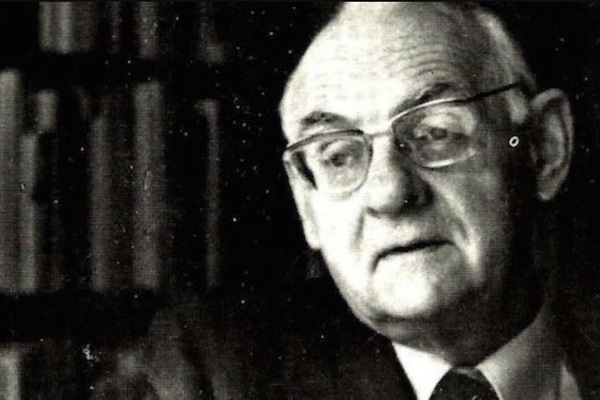
In memoriam: Edward A. Goerner, professor emeritus of political science

Edward A. Goerner, professor emeritus of political science at the University of Notre Dame, died Oct. 2 (Tuesday) at Memorial Hospital in South Bend. He was 82 years old.
A native of Brooklyn, N.Y., Goerner graduated from Notre Dame in 1952 and served three years in the U.S. Navy before earning a doctoral degree in political science from the University of Chicago in 1959. He taught for a year at Yale before joining the Notre Dame faculty in 1960.
A political theorist with a particular interest in religion and politics, Goerner was one of the University’s most popular teachers, once described in a student publication as “one of those unique individuals you can build an education around” and “a compelling lecturer who discusses political theory not in the intricate language of the academician but rather in the terms of the layman. The result is often discussion in Goerner classes which lasts 20 minutes beyond the bell.”
Professor Goerner was also a faculty fellow of the Nanovic Institute for European Studies.
Categories: Institute News
September 20, 2012
Nanovic Institute supports exclusive FTT Cannes documentary
Nanovic faculty fellow Aaron Magnan-Park took a team of eight current and former ND film students to the Cannes Film Festival this past May to create a documentary on the internship program run by the American Pavillion. The Nanovic Institute for European Studies was the first sponsor to commit to this ambitious project.
Categories: Institute News and News from Europe
September 13, 2012
Major New Archive in Russian History

Thanks to the efforts of faculty fellow Semion Lyandres (History) and crucial seed funding from the Nanovic Institute, Notre Dame has now unveiled a significant archive of primary documents that shed new light on the origins of modern Russia.
Acquired from Zinaida Leonidovna Polievktova-Nikoladze in Tblisi, Georgia, the archive contains three generations of materials collected by a family in Georgia descended from Niko Nikoladze, the father-in-law of Mikhail Polievktov, a prominent Russian historian from St. Petersburg.…
Categories: Institute News and News from Europe
August 15, 2012
History Ph.D. Student Awarded Fulbright to Switzerland
Adam Asher Duker, a graduate student in the University of Notre Dame’s Department of History, has been awarded a 2012 Fulbright to Switzerland, along with a Bourse de la Confédération Suisse. He also received a 2011-12 graduate travel and research grant from the Nanovic Institute for his project “Jerusalem Besieged: Israelite Identity and Holy War in France and Geneva, 1562-1598”.
Categories: Institute News
August 01, 2012
Rector of the Ukrainian Catholic University nominated Apostolic Exarch for Ukraines in France
Pope Benedict XVI nominated Rev. Borys Gudziak, one of our friends from the Catholic Universities Partnership, as Apostolic Exarch for Ukrainians in France, Belgium, Netherlands, Luxembourg, and Switzerland this summer. Full story…
Categories: Institute News and News from Europe
June 18, 2012
In memoriam: Sabine MacCormack, Hesburgh Professor of Arts and Letters

Sabine MacCormack, Rev. Theodore M. Hesburgh, C.S.C., Professor of Arts and Letters at the University of Notre Dame, died Saturday (June 16) after suffering a heart attack while gardening at her home in South Bend. She was 71.
A native of Frankfurt, Germany, MacCormack was educated there and in England, where she earned bachelor and doctoral degrees from Oxford University in 1964 and 1974, respectively. Before joining the Notre Dame faculty in 2003, she had taught history and the classics at the University of Texas at Austin, Stanford University and the University of Michigan.
MacCormack, a historian and classicist who taught and wrote about religion and culture in ancient Rome and colonial Latin America, was unusual among her international colleagues for the prominence of her scholarship in those two very different areas. She also was among Notre Dame’s most popular and affectionately regarded teachers, not only among the graduate students whose dissertations she directed, but also among first year students whom she taught in the required University Seminar course. A particular focus of her teaching, she said, was “on the nature of knowledge; on what we think we know, and why, and what we might actually know.”