The Monument of Salvation
- Site:
- Sofia, Bulgaria
- Student/Author:
- Anna Buckler ’27

Background
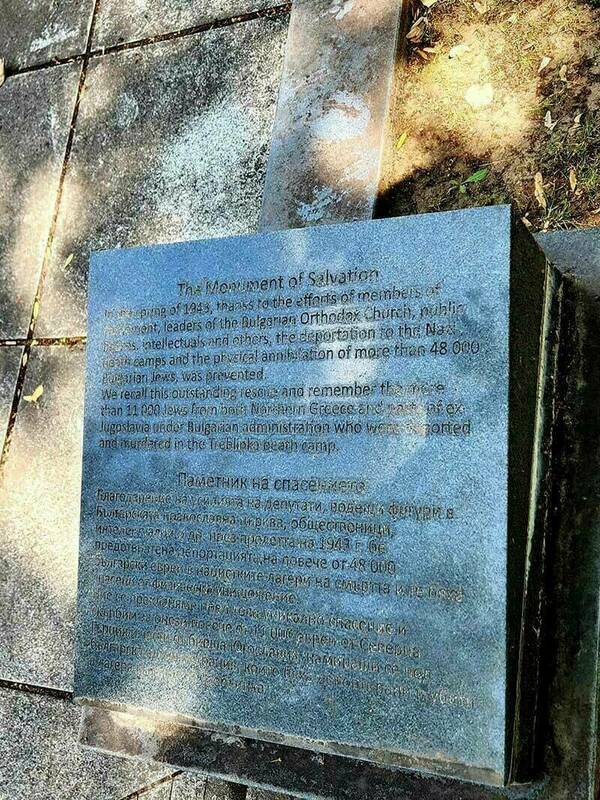
Among the many sculptures and historical monuments in the center of Sofia, Bulgaria’s capital city, the Monument of Salvation stands apart from the rest. It is exceptional in that it pointedly memorializes all of Bulgaria’s actions surrounding the deportation and treatment of Bulgarian Jews during World War II. Unveiled on July 7, 2016, the monument can be found in the gardens in front of the National Academy of Arts, near the St. Alexander Nevsky Cathedral (Ivanov 2023). The stone sculpture depicts the abstract forms of a man and woman embracing while emerging from the same point of origin. Their bodies are intertwined yet leave a space that holds the Star of David between them. The artists, sculptor Momchil Tsvetkov and architect Georgi Tsvetkov, began construction in 2013. Their design won a competition launched by Bulgarian Prime Minister Boyko Borissov to remember the 70th anniversary of the salvation of thousands of Bulgarian Jews from deportation and death (National Endowment Fund). The plaque next to the statue celebrates those whose lives were saved, but it also recalls the tragic part of this history by memorializing the Jews from neighboring territories under Bulgarian control who were not protected from deportation. This twofold remembrance of recent history, both positively and negatively, has brought about controversy over what parts of history should not be ignored but, quite literally, set in stone. It raises the question of whether sites should seek to commemorate, recalling people and events in a positive light, or memorialize and in so doing represent them as they were in all their dimensions, positive and negative. Thus, the Monument of Salvation has highlighted the growing endeavor to find a balance between these two forms of remembering: commemoration and memorialization.
During the Second World War, Bulgaria joined the Axis powers—primarily Germany, Italy, and Japan—signing the Tripartite Pact in 1941. In the early 1940s, Tsar Boris III of Bulgaria met with German leaders, allowed German troops to cross through the country’s borders, and encouraged Parliament to pass anti-Semitic legislation (Ragaru 2017). Bulgaria was also given military and administrative rule over certain territories within the Kingdom of Yugoslavia and Greece, including Macedonia and Thrace. Bulgarian government leaders signed agreements with Nazi Germany that allowed for the deportation of around 11,300 Jews living in these territories to Treblinka, a killing center located in German-occupied Poland. When word of these deportations spread, several key Bulgarian leaders, including the Vice President of Parliament, Dimitar Peshev, protested against additional persecution of Jewish people. Peshev was able to convince other members of parliament to sign a petition against the further deportation of Jews within Bulgaria, which eventually overwhelmed the Prime Minister (Yad Vashem). Their efforts, bolstered by the work of powerful leaders in the Bulgarian Orthodox Church and officially supported by Tsar Boris, prevented the deaths of the 48,000 Jews residing in Bulgaria in 1943. Though 48,000 Jewish lives were saved in Bulgaria, 11,300 Jews from Bulgarian-controlled territories were killed.
Analysis

The Monument of Salvation is a powerful example of how a nation can remember a past marked by both wrongful actions and heroic feats. Since the end of World War II in 1945 and the end of Communism in 1990, Bulgaria has struggled to create for itself a positive reputation while also accurately preserving its history, as it can often seem easier to simply selectively uphold heroic stories, and commemorate people who have impacted their country through bravery. Statues, parks, and murals portraying a positive past often help inculcate a sense of nationalistic pride. They also increase tourism. Purposefully recalling the harmful decisions made by past leaders that violated human rights or resulted in the deaths of innocent people, risks tarnishing a nation’s reputation. This predicament has led to debates over what to memorialize in statues and monuments (Klein 2023). Though some people may seek to forget or hide a nation’s regrets, it is essential to preserve a complete narrative of history without ripping out the pages that document times of tragedy.
The complex history of Bulgaria during World War II, marked by both tragedy and triumph, has led to disagreement over how to remember the period. Bulgaria has seen many protests as a result. In 2023, Bulgaria’s president, along with several other government and religious leaders, chose to honor the 80th anniversary of the salvation of the Jews by marching in remembrance of Tsar Boris III’s work to save the Jewish people of Bulgaria (Klein 2023). Their march reflected the public emphasis on the salvation of Bulgarian Jews, but without acknowledging the death of Jewish people from Bulgarian-controlled Thrace and Macedonia. This celebration was met with criticism from members of the Bulgarian Jewish community, who disagreed over “how Tsar Boris III should factor into Bulgaria’s Holocaust memory,” especially if his less-than-heroic actions were not to be recognized (Klein 2023). Many consequently decided to participate in their own ceremony to honor the anniversary and traveled to the site in Kavala, Greece from which Bulgarian soldiers deported Jews to Treblinka in 1943. Additionally, a group of Bulgarian scholars published an appeal to the Bulgarian state to publicly acknowledge and apologize for their past actions concerning the deaths of members of the Jewish community, rather than just glorifying and sanitizing the actions of Tsar Boris III (Klein 2023).
The controversy surrounding this period in Bulgaria’s past illustrates how hard it can be to preserve memory as history. As time passes, stories told over generations change, and societies can forget the details that were once deemed unimportant. This is where statues and memorials play an important role. Placed in an accessible location and accompanied by a descriptive plaque in both English and Bulgarian, the Monument of Salvation functions as a site of memory for the people of Sofia. It is there to remind them of their history in all its valences, including the deportation of Jews from Macedonia and Thrace in 1943. This is a story of which not many Bulgarians are aware. More specifically, the wording on the plaque makes an effort to uphold accountability and transparency for Bulgarians, admitting that the territories were under Bulgarian administration and that the Jews living there were not just deported, but murdered. Monuments can sometimes be imperfect repositories for difficult pasts, but the Monument of Salvation is a complex and, in some ways commendable, site of memory because it emphasizes the importance of taking responsibility for all historical actions. It allows the Bulgarian people to recall the whole story, and both mourn lives lost and celebrate lives saved.
Works Cited
Ivanov, Ivo. 2023. “Monuments of the Rescuers and the Rescued in Sofia.” BNR: Radio Bulgaria. 10 March. https://bnr.bg/en/post/101791185.
Klein, David I. 2023. “Why Bulgarian Jews Skipped an Official Ceremony Marking their Rescue from the Nazis.” The Times of Israel. 17 March. https://www.timesofisrael.com/why-bulgarian-jews-skipped-an-official-ceremony-marking-their-rescue-from-the-nazis/.
Ragaru, Nadège. 2017. “Contrasting Destinies: The Plight of Bulgarian Jews and the Jews in Bulgarian-Occupied Greek and Yugoslav Territories during World War Two.” SciencesPo. 15 March. https://www.sciencespo.fr/mass-violence-war-massacre-resistance/en/document/contrasting-destinies-plight-bulgarian-jews-and-jews-bulgarian-occupied-greek-and-yugoslav-.html
The National Endowment Fund: 13 Centuries Bulgaria. “Monument: Symbol of Salvation of Bulgarian Jews.” The National Endowment Fund “13 centuries Bulgaria. https://fund13veka.bg/portfolio_page/паметник-символ-на-спасяването-на-б 2/?lang=en.
Yad Vashem. “The Righteous Among the Nations: Dimitar Peshev.” Yad Vashem: The World Holocaust Remembrance Center. https://www.yadvashem.org/righteous/stories/peshev.html.
About the Author
Anna Buckler '27 is a global affairs and Theology major and a member of the Band of the Fighting Irish. She traveled to Sofia, Bulgaria, and wrote about the Monument of Salvation for the Sites of Memory in Contemporary Europe project. She was traveling as part of the Nanovic Institute's Serving (in) Europe volunteer program during the summer of 2024.