Where can hope be found in wartime? In small victories, certainly. But also in the belief of something bigger, in the hope that peace will prevail. Institutions like the University of Notre Dame and Ukrainian Catholic University would call that faith.
For 22 years, Notre Dame has sustained a partnership with Ukrainian Catholic University (UCU), rooted in a shared Catholic identity. That partnership expanded in 2022 after the full-scale Russian invasion of Ukraine, when Notre Dame added new programs and funding for research grants. Sixteen grants, funded by Notre Dame Global and Notre Dame Research, have been awarded since 2022 to ND and UCU faculty to pursue joint research on concerns central to Ukraine.
Additionally, in 2023, the Nanovic Institute launched the Ukrainian Studies Hub—a University-wide initiative that brings together scholars and students focused on Ukraine. The Hub leads education and research initiatives and serves as a platform for building partnerships in Ukraine and responding to the critical challenges facing Ukrainians and the global community. It brings to life Notre Dame’s work as a founding member of the Global Coalition of Ukrainian Studies, and, in partnership with UCU, also hosts a biennial conference at Notre Dame.
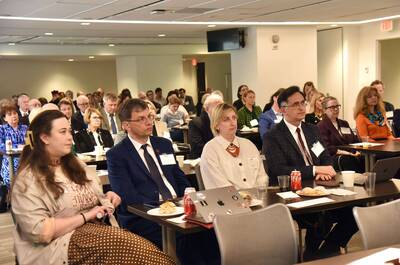
The vitality and continued growth of this university partnership were evident at the recent gathering of the Notre Dame and UCU community in Washington, D.C. Over 100 people came together for The Ukraine Impact Forum: Faith & Resilience. The forum took place at Notre Dame’s Washington Office, providing a vital nonpartisan venue for US and Ukrainian leaders to engage, and was co-organized by Notre Dame Global, the Keough School of Global Affairs, the Nanovic Institute for European Studies, Notre Dame Research, and Ukrainian Catholic University. It brought together faculty and staff from both institutions, civic activists, partners, politicians, and Notre Dame alumni. The goal of the forum was not only to present on joint research projects, but also “to impact policy and future research, start conversations, and engage colleagues and partners around the world,” as Michael Pippenger, Notre Dame’s vice president & associate provost for internationalization, shared in his opening remarks.
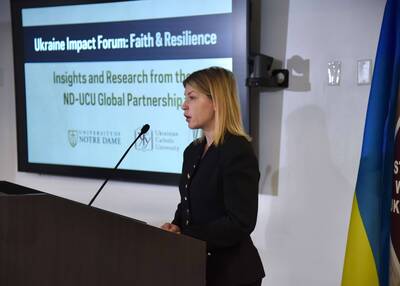
Other key speakers included Ambassador Olha Stefanishyna, Ukraine’s Ambassador to the United States; Archbishop Borys Gudziak, Metropolitan-Archbishop of the Ukrainian Catholic Archeparchy of Philadelphia and UCU president; Taras Dobko, UCU rector; Yaroslav Prytula, UCU senior vice-rector and provost; Sophia Opatska, UCU vice-rector of strategic development; Jeffrey Rhoads, John and Catherine Martin Vice President for Research at Notre Dame; and Mary Gallagher, dean of Notre Dame’s Keough School of Global Affairs. The forum was also honored to welcome senior government officials, including Naz Durakoğlu, Staff Director, Senate Foreign Relations Committee.
Throughout the course of the day’s events—filled with fireside chats, talks, and presentations—a clear thread emerged. This was a partnership grounded in faith and energized by putting that faith into action.
During her remarks, Ambassador Stefanishyna spoke to the importance of not just academic diplomacy but faith diplomacy: “In times of uncertainty, faith remains the only ground which keeps us united.” She also discussed universities’ role in conflicts, stating that the shared objective of universities is to “translate research into politics and insights into action.” She noted how universities in Ukraine, such as UCU, are turning their experience of crisis into actionable knowledge—exemplified through Ukraine becoming more technologically advanced due to the war.
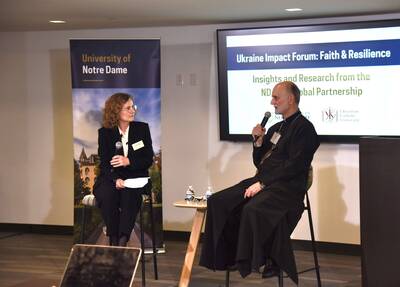
When asked during his conversation with Dean Gallagher what Catholic universities specifically can do in the midst of conflict, Archbishop Gudziak answered, “Do what we do, but do it heart to heart.” Catholic universities are as well-positioned as other universities to provide partnership, research, and resources to those in need. But a Catholic foundation allows institutions to go one step further, emphasizing “integral human development.” This holistic approach recognizes that lasting recovery depends on the development of the whole person, and that researchers at ND and UCU consider data in the context of the human lives and communities it represents.
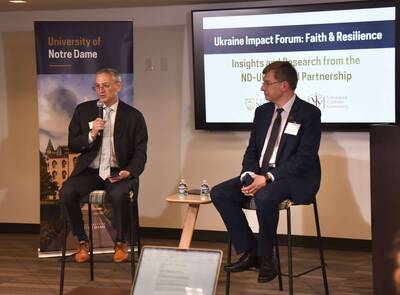
During the fireside chat between Pippenger and Dobko, the two discussed what it means to serve at faith-based institutions in a secular society. “I think faith-based institutions are particularly capable, and they have a mission to increase the number of dedicated and passionate people,” Dobko said. Reflecting on UCU’s role in the current crisis, he shared that “UCU should be a source of hope and a source of unity for the Ukrainian people.” For UCU, putting their faith into action means cultivating hope not just among their students and on their campus, but also putting scholarship, research, and science into action to improve the lives and resilience of the Ukrainian people as a whole.
Pippenger remarked on how Notre Dame has learned from UCU’s ability to reinvent the university to meet the needs of a society under duress, to which Dobko emphasized that universities should be communities that not only teach but also learn. “This learning experience comes from responding to the present,” he says. One of the ways Notre Dame and UCU are fostering hope and reacting to the current situation is through research. As Pippenger shared, “We are being led by our hearts, we’re being led by our faith, but it allows us to do practical work that will be transformative in the secular world.”
Some of that practical work was presented at the forum, where faculty teams—each pairing a Notre Dame faculty member with an UCU colleague—presented updates on their ongoing research projects that involved a diverse set of themes and disciplines related to the ongoing conflict, including collective trauma and healing, ethical infrastructure and moral dimensions of security, data science for the common good, and the role of religious diplomacy in the ongoing war. These projects showcased how collaborative scholarship can be a profound form of solidarity and how the synergy between the spiritual and the empirical served as the forum’s true North Star. By presenting rigorous, policy-relevant findings on the ethical infrastructure of reconstruction alongside the data-driven strategies for human resilience, the ND-UCU researchers demonstrated that faith and scholarship are not at odds; they are the dual engines of Ukraine’s resistance, recovery, and reconstruction. One provides the ‘why’—the inherent dignity and moral security of the person—while the other provides the ‘how’—the technical expertise needed to rebuild a sovereign, flourishing society.
This resilience is forged in profound sacrifice; as noted during the forum, the UCU community has already lost 38 of its students, alumni, faculty, and staff to Russian attacks—lives that the partnership seeks to honor through its commitment to a free and flourishing Ukraine. Behind each name is a “whole person”—a world of unique talents, deep family bonds, and vocations cut short.
In offering closing remarks, Clemens Sedmak, director of the Nanovic Institute for European Studies and professor of social ethics at the Keough School, emphasized that research projects like these give people reasons to care and overcome the temptation to indifference in the face of great conflict. “Why should you care?” he asked. “Because people are precious, the stakes are high, and the injustice is grave.”
The participants’ presence at this forum was proof that they understood the imperative, but the work is far from over. As Dean Gallagher reflected on the closing remarks, she asked Archbishop Gudziak whether he had a call to action to offer the group as they considered their own commitments in response to the sessions. He shared three: “Pray, because we've seen too many miracles not to understand that God intervenes in history. Second, advocate, inform, be informed, and inform others. And third, help as you can, everybody according to their talents and their means.”
At the end of the day’s talks, Sedmak asked Archbishop Gudziak to lead the group in a closing prayer before the reception. Archbishop Gudziak approached the mic and, instead of leading the group in a typical spiritual reflection, he invited those present to join in prayerful song in Ukrainian. Within seconds, his voice was joined by the Ukrainian members of the gathering. Reflecting on this moment, Pippenger mentioned, "There was a palpable sense of unity in the room. The participants of the Notre Dame and UCU community were united by their faith, by a commitment to preserving the cultural identity resonating throughout the room, and by a shared desire for the common good of one another."
Originally published by at global.nd.edu on May 18, 2026.