
By Elise Wollemborg
Under the financial support and guidance of the Nanovic Institute, I carried out an independent service project during the summer of 2025 entitled "Pilgrimage and Presence: Exploring Accompaniment in a European Catholic Sanctuary”. I worked in the first aid office under the supervision of medical professionals, assisting visiting pilgrims. My days were spent in the first aid office, the childcare room, and tending to the various needs of the Sanctuary.
I am grateful for Nanovic Institute grant funding, which enabled me to travel to Lourdes and serve as a volunteer in the sanctuary’s hospitality mission. As a lifelong Catholic and curious future physician, I was and am drawn to the intersection of the scientific and spiritual dimensions of healing. I was hopeful that my time in Lourdes would be an opportunity to serve while simultaneously studying accompaniment–the practice of walking with the sick–in an international, faith-centered setting which has welcomed and served pilgrims for over a century. Further, I was confident my time accompanying these pilgrims would allow me to simultaneously observe and reflect on the manner by which the pilgrim experience at Lourdes preserves human dignity in moments of profound vulnerability.
My volunteering experience provided me with invaluable experiences which deepened my understanding of human dignity, healing, and my own faith. Additionally, my time at Lourdes increased my understanding of the rich pilgrim experience Lourdes offers within a deeply European context. Engaging with Lourdes as both a spiritual and cultural site rooted in European Catholic tradition allowed me to successfully explore the manner by which historical and continental influences shape contemporary practices of care and faith within Europe.
As a student preparing for a career focused within the context of global medicine, I am deeply committed to and inspired by Notre Dame’s mission of educating the heart and the mind. My project was structurally a direct extension of that mission. By entering into the sacred space of Lourdes, I returned with insights I am confident enriched my understanding of the university’s understanding of faith in practice, and ultimately, will allow me to become a physician who embodies and carries out the values of healing, dignity, and presence to whomever I serve.
I am deeply grateful for the opportunity to engage in service at a site so central to the Catholic imagination and so personal to my own journey. Volunteering at the sanctuary last summer was a profoundly moving experience, not solely because of the spiritual power of the space, but rather because of the people I had the privilege of accompanying. Each day of service at Lourdes is centered on simple acts of care: pushing wheelchairs, offering water, and praying silently beside pilgrims as they approach the healing waters. In these moments, I saw accompaniment not as something abstract, but as a sacred discipline—a practice of radical attentiveness to human dignity in all its fragility and fullness.
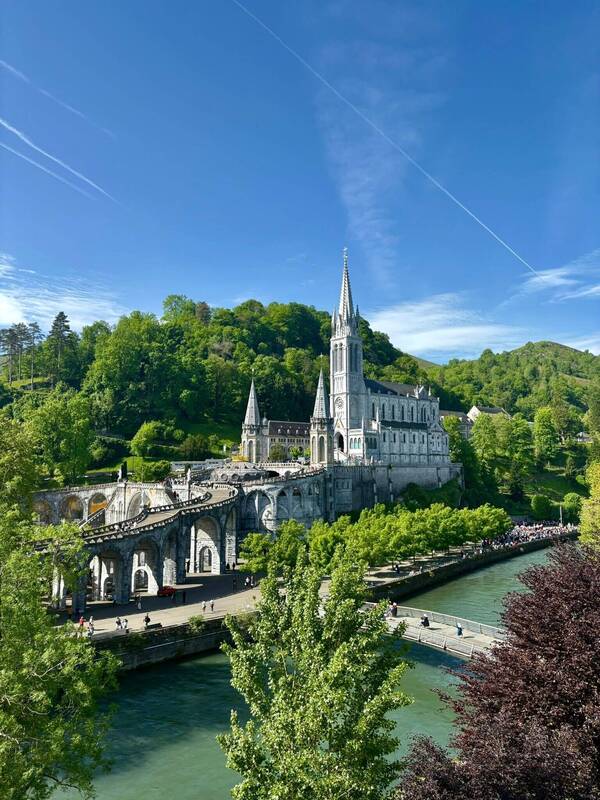
One of the most impactful parts of my week was witnessing the manner by which ritual is capable of framing suffering and of creating communal space for hope. Whether through the nightly candlelit procession or the quiet reverence of the baths, I observed how structured liturgy helps give meaning to illness and allows for a kind of healing that transcends the biomedical. My time in Lourdes reinforced a notion which I had long believed: that healing often arises not from cure, but from presence. This experience is shaping how I think about clinical care as a future physician. It also affirmed my desire to study and practice medicine in a manner that honors both the physical and spiritual dimensions of health.
This experience allowed me to support individuals from around the world, many of whom arrived seeking physical or spiritual healing, and to witness firsthand the profound role of accompaniment in healthcare and faith. Working alongside both healthcare staff and fellow volunteers, I gained valuable experience in patient-centered service, cross-cultural interaction, and the integration of compassion into clinical care. It was this unique combination of medical, spiritual, and community dimensions at Lourdes which deepened my interest in medicine as a vocation of service and in turn reinforced my commitment to exploring healthcare through both scientific and humanistic lenses. Once again, this experience strengthened my resolve to value technical excellence in my future career without losing sight of the human, cultural, and spiritual dimensions of patient care.
My time at Lourdes was made possible by the Nanovic Institute, and I am deeply grateful for their support.