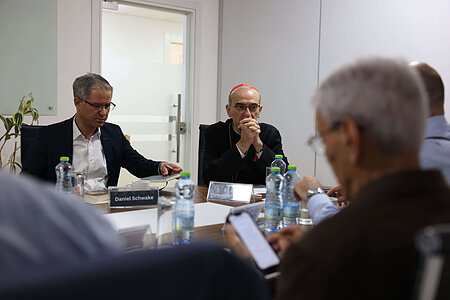
tag:nanovic.nd.edu,2005:/newstag:nanovic.nd.edu,2005:/latestNanovic Institute | News2026-09-01T12:13:00-04:00The Nanovic Institute for European Studies connects the University of Notre Dame with Europe through academics, grants, research, and global opportunities.tag:nanovic.nd.edu,2005:News/1853412026-09-01T12:13:00-04:002026-09-08T11:13:32-04:00Latin Patriarchate of Jerusalem to launch academic forum in partnership with Notre Dame Notre Dame Jerusalem's Daniel Schwake and Cardinal Pizzaballa during a workshop in Jerusalem
His Beatitude Cardinal Pierbattista Pizzaballa, Latin Patriarch of Jerusalem, will formally launch “Within Your Gates: The Forum for the Universal Vocation of Jerusalem” on Sept. 7 in partnership with Notre Dame Jerusalem, the University of Notre Dame’s academic center in Jerusalem.
The forum is an interdisciplinary research initiative that will bring together scholars and practitioners from different faith traditions and disciplines to engage with Jerusalem's universal mission and its significance for those who reside within the Holy Land and beyond.
“One of our most important responsibilities as Christians is to discern God’s call for us and to use our talents and gifts to serve Him and the world,” said Rev. Gregory P. Haake, C.S.C., vice president for mission engagement and church affairs. “This forum creates a space for us to discern Jerusalem’s unique vocation of bringing together peoples of many faiths to build bridges and to receive God’s call to be peacemakers. I am proud that Notre Dame is working with Cardinal Pizzaballa to realize this vision of how discovering Jerusalem’s vocation can lead us to knowledge of our own.”
The forum will produce applied interdisciplinary research rooted in Jerusalem’s particular realities and oriented toward questions of daily life that resonate beyond the city and the surrounding region, exploring themes such as the theological significance of Jerusalem, the city's universal vocation, the language of conflict and reconciliation, and agency under conditions of constraint.
Cardinal Pizzaballa, who will chair the forum’s Board of Promoters, will share his vision for the initiative at the Sept. 7 launch event at the University’s Tantur campus. “The mission of earthly Jerusalem is to become the image and mirror of heavenly Jerusalem, a prophecy and promise of that universal reconciliation and peace which God desires for the whole human family,” he said. “It is to this mission that we must return.”
The Sept. 7 launch event will include remarks from Cardinal Pizzaballa as well as scholars and practitioners who serve on the forum’s Board of Promoters or the Advisory Committee.
Originally published by Notre Dame Jerusalem at jerusalem.nd.edu on Sept. 1.
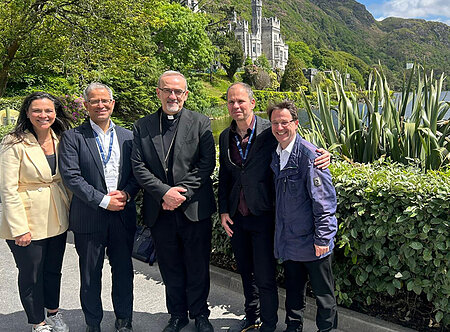
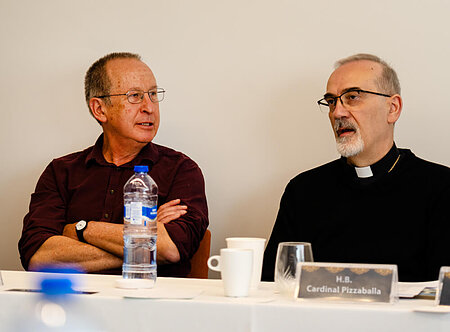
Cardinal Pizzaballa at Kylemore Abbey with Notre Dame Kylemore Director Lisa Caulfield, Daniel Schwake, Gabriel Schwake (Vrije Universiteit Amsterdam) and Clemens SedmakAsher Kaufman sits alongside Cardinal Pizzaballa during a workshop in Cyprus.
Originally published by Notre Dame Jerusalem at jerusalem.nd.edu on September 01, 2026.
]]>
Notre Dame Jerusalemtag:nanovic.nd.edu,2005:News/1853402026-09-01T11:12:00-04:002026-09-08T11:12:20-04:00Kylemore Abbey and Notre Dame celebrate a decade of partnership at Threshold Festival
Kylemore Abbey and the University of Notre Dame at Kylemore Abbey proudly marked 10 years of their partnership during the Threshold Festival, a four-day celebration of literature, music, theatre, visual art, scholarship and hospitality in the extraordinary setting of Kylemore Abbey.
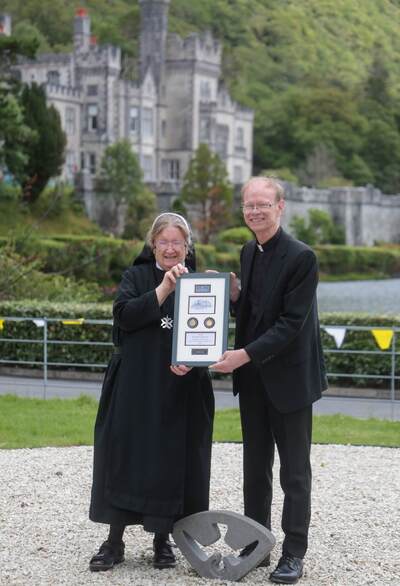
The anniversary was marked with a special presentation from the Benedictine Community of Kylemore to Rev. Robert A. Dowd, C.S.C., president of the University of Notre Dame, on Thursday, July 30. The presentation commemorated the first decade of a landmark 30-year agreement between Kylemore Abbey and Notre Dame, which established the University’s global campus within the historic St. Joseph’s Wing of Kylemore Castle.
Since welcoming its first students in 2016, the University of Notre Dame Kylemore has become a vibrant hub for academic study, leadership development, research, retreats, workshops and international events, developing meaningful connections between Ireland and the Notre Dame community.
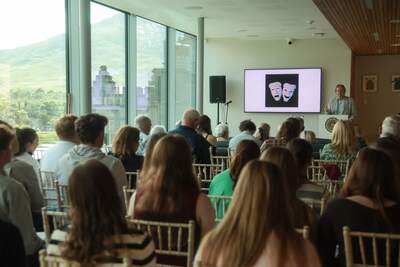
This year’s Threshold Festival, themed “The Smiling Public Figure: Wit, Satire and Irony in W.B. Yeats,” brought together leading scholars, artists, performers and cultural partners to explore Yeats’ work and legacy through performance, conversation and creative encounters.
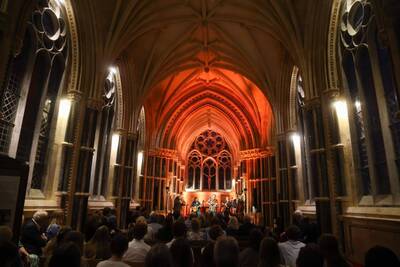
Festival highlights included the launch of the visual art exhibition Threading the Threshold: Care, Craft and Celtic Revival, and an opening banquet celebrating Connemara hospitality. The weekend also featured live music in Kylemore's Gothic Chapel, including a performance by NoCrows and an intimate unplugged set from Steve and Joe Wall of The Stunning.
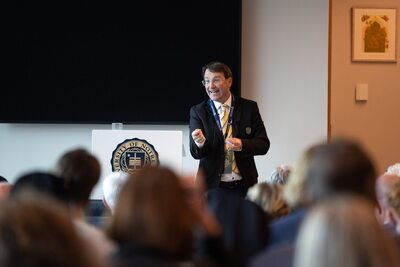
Academic and cultural programming featured leading voices in Irish studies, including Oxford historian and Yeats biographer Roy Foster, who delivered a lecture on humor and Yeats; Clemens Sedmak, director of Notre Dame's Nanovic Institute for European Studies, who spoke on “Learning from the Benedictines: Dignity, Flourishing and Integral Human Development;” and Yeats postdoctoral fellow Eilís Smyth, who gave a talk on Shakespeare, Yeats and the Lyric Theatre.
A major highlight of the weekend was the Abbey Theatre’s contribution to the festival program: a panel discussion titled “You Have Disgraced Yourselves Again,” reflecting on Yeats, Lady Gregory, the Irish dramatic movement and the continuing role of Irish theatre in shaping cultural life. The Abbey Theatre also presented a staged reading of Yeats’ The Green Helmet: An Heroic Farce in the Gothic Chapel, vividly bringing Yeats’ wit, mythic imagination and theatrical energy to life.
The festival concluded with a special black-tie evening in partnership with Wexford Festival Opera, featuring Wexford Sings: Italy Through the Eyes of Yeats. The performance paired Italian opera by composers including Verdi, Puccini and Rossini with Yeats’ poetry, creating a distinctive conversation between music, poetry, wit and place.
Lisa Caulfield, director of Notre Dame Kylemore, said, “It was an amazing weekend in every sense — full of beauty, laughter, conversation, music, theatre and friendship. I feel so grateful to be surrounded by such good people and such high-calibre artists, scholars and partners. Their generosity, talent and spirit made Threshold a very special celebration, and a fitting way to mark 10 years of Notre Dame Kylemore.”
As part of the anniversary celebrations, the Benedictine Community presented Father Dowd with a commemorative gift in recognition of the enduring partnership and the shared vision that has shaped the success of the Kylemore campus over the past 10 years. The event also included a special anniversary Mass with the Benedictine Community, celebrated by Father Dowd, marking 10 years of Notre Dame’s presence at Kylemore Abbey.
Reflecting on the milestone, Kylemore Abbey and the University of Notre Dame reaffirmed their commitment to continuing this unique collaboration, which brings together academic excellence, cultural exchange and the Benedictine values of hospitality, community and lifelong learning.
Speaking at the celebration to mark the anniversary, the Abbess of Kylemore, Mother Karol O’Connell OSB, said: “Since the foundation of our Benedictine Community in Ypres, Belgium, in 1665, education has been at the heart of our mission. Generations of girls attended our schools and today, through our Education and Retreat Centre, we continue to make Kylemore a place of learning. Our partnership with the University of Notre Dame is another mark of this commitment to education, and we look forward to the further flourishing of this partnership.”
“We are delighted to mark 10 years of partnership between Notre Dame and the Benedictine Community at Kylemore Abbey,” Father Dowd said. “As a global Catholic research university, we are grateful for the ways that the partnership has deepened our connectedness to Ireland and furthered our efforts to educate in ways that build bridges across disciplines, ideas, peoples and cultures. We are deeply grateful for the vision of Martin and Carmel Naughton and of Mother Máire Hickey OSB who made this unique partnership possible. As we celebrate 10 years, we look forward to the future in a spirit of collaboration and partnership.”
The late Martin Naughton’s vision and generosity were instrumental in bringing the campus to life. In May 2026, Emma Kirner, research programs manager, interviewed Naughton about the University of Notre Dame Kylemore. Asked to describe it, he offered the following: “Notre Dame Kylemore is a spiritual place.”
Over the next two decades, Kylemore Abbey will continue to welcome generations of Notre Dame students, scholars, faculty, alumni and visitors to the unique Connemara estate. Through this partnership, Kylemore will continue to strengthen its role as a place of learning, reflection, cultural exchange and global engagement.
Originally published by Lily Mansfield at kylemore.nd.edu on Aug. 20.
]]>
Lily Mansfieldtag:nanovic.nd.edu,2005:News/1850872026-08-26T13:59:00-04:002026-08-26T13:59:31-04:00Keough School welcomes five new faculty and Visiting Professors of the Practice
As the 2026-27 academic year begins, the Keough School of Global Affairs is welcoming five new faculty who bring extensive expertise in politics and international relations, modern Irish and Ukrainian studies, national security, sustainability, entrepreneurship and more.
Left to right: Rory Finnin, Emma Murphy, Fr. James Lies. Photo by Daniel Hilles.
“The work of our newest colleagues — and the critical questions they address — is more vital than ever,” said Mary Gallagher, the Marilyn Keough Dean of the Keough School. “From the study of moral psychology and transitional justice to the imperatives of sustainable enterprise and international law, these experts embody the Keough School’s commitment to connecting rigorous scholarship and real-world impact. They bring diverse perspectives that will not only advance our research but will also challenge our students to think critically and creatively about how to apply their own knowledge, values and skills to the most pressing challenges of our time.”
New faculty include:
Rory Finnin Notre Dame Collegiate Mission Chair in Ukrainian Studies Director, Nanovic Institute for European Studies’ Ukrainian Studies Hub
Finnin was most recently a visiting professor of Ukrainian studies in the Keough School's Nanovic Institute for European Studies. Prior to coming to Notre Dame, he was professor of Ukrainian studies at the University of Cambridge, where he established the Cambridge Ukrainian Studies program in 2008.
Finnin has curated and organized more than 40 exhibitions and cultural events, advancing public understanding of Ukraine’s language, history and society in the U.K. and beyond. His research focuses on the interplay between culture and identity in Ukraine, with particular attention to Crimea and Crimean Tatar literature, and his broader interests include nationalism studies, solidarity studies and cultural memory in the Black Sea region. He holds a Ph.D. in Slavic languages and comparative literature from Columbia University. He is also a returned Peace Corps volunteer who served in Ukraine from 1995 to 1997. He is also a core-affiliated faculty member of the Nanovic Institute.
Fr. Lies, C.S.C., joins the Keough School faculty after serving as senior advisor for faculty fellow affairs and partnerships at the Keough School’s Nanovic Institute for European Studies. A priest of the Congregation of Holy Cross and a developmental and moral psychologist, Lies teaches and writes about the human dimensions of diplomacy, leadership, conflict, moral judgment and ethical decision-making. His teaching connects psychological theory and research with the practical and ethical challenges of global affairs, examining how identity, culture and perception shape decision-making, conflict and leadership.
Lies holds a doctorate in developmental psychology from the University of Minnesota, a Master of Divinity from the Jesuit School of Theology at Berkeley and a master’s degree in counseling psychology from the University of Notre Dame. He is also a core-affiliated faculty member of the Nanovic Institute.
Emma Murphy Assistant Professor of Modern Ireland and Peace Studies
Murphy most recently held a postdoctoral position with the Clingen Family Center for the Study of Modern Ireland in the Keough School's Keough-Naughton Institute for Irish Studies and the Peace Accords Matrix at the school's Kroc Institute for International Peace Studies. As part of this work she supported the Legacy Project, which preserves and engages the digital archive of the Colombian Truth Commission, and explored the lessons the Colombian peace process holds for Ireland. More broadly, Murphy’s research focuses on transitional justice; the politics of divided societies; identity in post-conflict societies; Irish politics and feminist and postmodern political theory. She holds a doctorate in politics and international relations from University College Dublin, where she was an Irish Research Council Laureate Award-affiliated fellow. She is also a core-affiliated faculty member of the Keough-Naughton Institute.
Reynolds teaches courses that prepare students to examine how organizations integrate sustainability into business strategy, operations and global supply chains. He also supports the McKenna Center's Urban Poverty and Business Initiative, particularly the South Bend Entrepreneurship and Adversity Program, where he works with students and entrepreneurs to foster entrepreneurship and expand economic opportunity. Reynolds’ professional experience spans global supply chain management, manufacturing and operations, executive consulting and organizational transformation. He came to Notre Dame through the Inspired Leadership Initiative following senior leadership roles in global consulting and industry. He holds a B.S. in mechanical engineering from Cornell University and a master of business administration in finance and international business from New York University. He is also a core-affiliated faculty member of the McKenna Center.
Lia Brazil Assistant Professor of Modern Ireland
Brazil will join the Keough School in January 2027 from the University of Manchester’s Humanitarian and Conflict Response Institute where she is a Leverhulme Trust research fellow. She was previously a National Endowment for the Humanities Visiting Fellow at the Keough Naughton Institute and a postdoctoral research fellow at Nuffield College, University of Oxford. She received her doctorate in history from the European University Institute, Florence. Brazil’s research centres on the history of humanitarianism, international law and human rights. She is interested in how history has informed the challenges facing NGOs today, the role of individuals under international law, and comparative and global perspectives on modern Ireland. At the Keough School she will begin a new project on human rights and modern Ireland.
Frank Macchiarola, visiting professor of practice, is a senior energy policy and government affairs leader specializing in clean energy and energy policy. He is the chief advocacy officer of American Clean Power, where he leads government affairs and political engagement at the federal and state levels. He previously held senior leadership roles at the American Petroleum Institute and America’s Natural Gas Alliance and served as staff director of the U.S. Senate committees on Energy and Natural Resources and Health, Education, Labor and Pensions.
Daniele Nyirandutiye, visiting professor of practice, is a global strategist and senior policy practitioner specializing in U.S. foreign policy, development finance, investment and Africa. She has served at the White House National Security Council and as a U.S. diplomat with USAID, including as USAID mission director in Uganda. She brings experience working across government, the private sector and civil society to advance development, governance and inclusive economic growth in frontier markets.
David Shullman, visiting professor of practice, is a national security and China policy expert with extensive experience in U.S. intelligence, foreign policy and strategic analysis. He recently served as the national intelligence officer for China on the National Intelligence Council, where he was the principal advisor on China to senior U.S. policymakers. He previously served in senior roles at the Atlantic Council, the International Republican Institute and the Central Intelligence Agency.
Macchiarola, Nyirandutiye and Shullman are joining current visiting professors of the practice Amy McAuliffe and Peter Quaranto.
Originally published by April Toler at keough.nd.edu on August 25, 2026.
]]>
April Tolertag:nanovic.nd.edu,2005:News/1849602026-08-24T00:20:00-04:002026-08-24T00:19:49-04:00Why Ukraine: Notre Dame's Vision for a Vital Field“Why Ukraine”—not a question, an assertion.
In celebration of Ukraine's Independence Day — coinciding today with the start of the 2026-27 academic year — the Notre Dame Ukrainian Studies Hub articulates its distinctive vision for the study of Ukraine.
The Ukrainian Studies Hub advances research, teaching, and public engagement to understand Ukraine — and what Ukraine teaches us about the world. With a commitment to the education of body, mind, and spirit, the Hub seeks to learn about, learn from, and learn with the people of Ukraine.
We study Ukraine as a place from which to rethink some of the fundamental questions of the twenty-first century. Ukraine is where culture sustains itself against aggression and erasure, where civil society innovates and rebuilds from within, where faith traditions join in solidarity to deepen the moral vocabulary of resistance and justice, and where AI and other emerging technologies reshape warfare and the conditions of truth.
These are among the defining global intellectual and spiritual challenges of our time.
The Rector of the Ukrainian Catholic University, Taras Dobko, has called Ukraine “a laboratory for social transformation, innovation, and experimentation.” The Hub takes this insight as an intellectual invitation to galvanize interdisciplinary work at Notre Dame around questions of ethical inquiry and the common good. It presents Ukraine not only as an object of knowledge, but as a subject through which we confront the entanglements of power, knowledge, and human dignity.
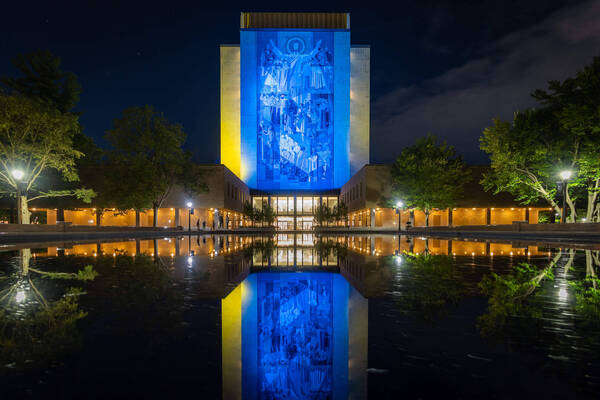
Notre Dame's Hesburgh Library illuminated in blue and yellow in observance of Ukrainian Independence Day, August 24, 2025 (Photo by Michael Caterina/University of Notre Dame)
Who We Are
Located in the Nanovic Institute for European Studies at the Keough School of Global Affairs, the Notre Dame Ukrainian Studies Hub is an interdisciplinary community forged by a deep partnership with Ukrainian academe and animated by intellectual rigor and the aspirations of Integral Human Development (IHD)—a holistic vision, grounded in Catholic social teaching, of the flourishing of every person and the whole person.
What makes the Hub distinctive is its conviction that the humanities are indispensable to understanding what is most consequential about Ukraine’s past, present, and future; that the questions raised by Ukrainian Studies are both urgent and universal; and that coming to grips with Ukraine's complexity requires scholarship and policy to attend to the moral as much as the material.
At the heart of this work is the University of Notre Dame’s longstanding partnership with the Ukrainian Catholic University (UCU), one of Europe’s most courageous and creative academic institutions. Since 2004, Notre Dame has forged a unique relationship with UCU’s students and scholars, who are expanding the moral and intellectual horizons of higher education. This partnership is the foundation of the Hub, but not its boundary.
What We Do
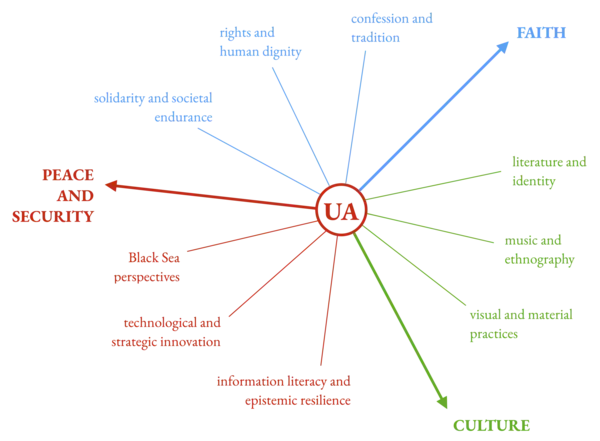
The Notre Dame Ukrainian Studies Hub is organized around three primary intellectual vectors that explore the connections between meaning-making, moral imagination, and political order.
Culture – studying the dynamic artistic and expressive traditions through which Ukrainians—and Crimean Tatars, Ukraine’s indigenous Sunni Muslim people—have forged and defended identities across centuries.
Faith – exploring Ukraine’s diverse confessional landscape and the role of religious tradition in enacting solidarity and articulating a defiant vision of human dignity. This realm is too often ignored in the conventional study of international relations.
Peace and Security – viewing Ukraine’s geopolitical and geostrategic significance through what Mykhailo Hrushevsky once described as a “Black Sea orientation.” Russia’s war of aggression began with the seizure of Crimea and escalates through Crimea, underscoring how control of the peninsula—and of the wider Black Sea region—remains decisive for questions of sovereignty, global food security, and the architecture of a durable postwar order.
Across these vectors, the Hub demonstrates what a research university can do when scholarship becomes partnership and when knowledge becomes encounter:
In the classroom
Shared, experiential learning is our touchstone. Classes in the Ukrainian language and courses in Ukrainian history and culture at Notre Dame draw students from across the University—from engineering and business to theology and the arts. Collaborative Online International Learning (COIL) projects bring Notre Dame and Ukrainian students together in virtual classrooms to study history, culture, religion, and peace. Summer schools and study-abroad programs bring Notre Dame and Ukrainian students together in person in Croatia and Poland to explore questions of recovery, cultural heritage, and faith.
Notre Dame and UCU students and scholars in a COIL classroom (Photo by Matt Cashore/University of Notre Dame)
In research
Scholars from Notre Dame and Ukraine join forces through visiting fellowships and joint grant-funded projects to investigate subjects from urban planning to the history of Catholic resistance under communism. Collaborative student research produces permanent resources, including the digital exhibitions Ukrainian Art as Protest and Resilience and Writing the War in Ukraine.
In publications
Notre Dame and UCU have collaborated on books including The Trauma of Communism (2022), Resilient Universities (2024), and Facing Russian Aggression: Struggle for Security and Peace in Europe (2025). In partnership with the University of Notre Dame Press, the Hub is also launching a new book series in Ukrainian Studies, edited by Professor Yury Avvakumov, beginning with an English translation of Myroslav Marynovych’s The Ukrainian Idea and Christianity.
In the public square
The Hub convenes scholars, students, policymakers, artists, and civic leaders through conferences and policy fora. Film series extend these conversations to wider audiences. Following the inaugural 2025 conference Revolutions of Hope: Resilience and Recovery in Ukraine, the Hub is preparing The Duty of the Good Life: Ukrainian Perspectives on Living on the Edge for March 2027. The Hub is a full member of the Global Coalition for Ukrainian Studies and the driving force behind the new Midwest Alliance for Ukrainian Studies.
Into practice
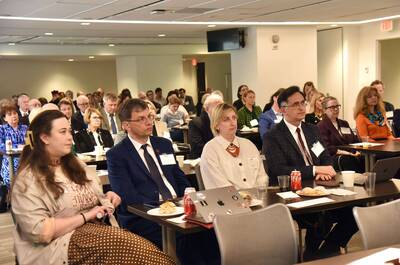
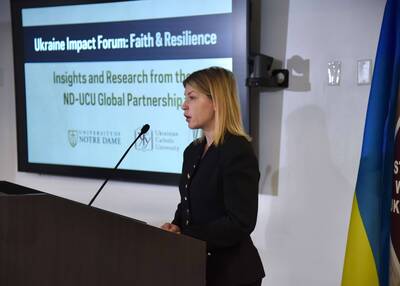
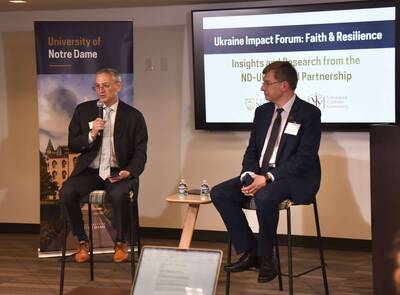
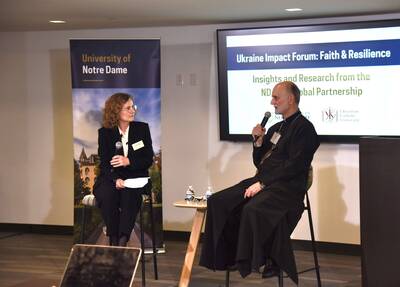
The Hub seeks to bring scholarship into direct, sustained exchange with policymakers, practitioners, civil society leaders, and cultural institutions. Research and teaching shape practice; practice informs research and teaching. In 2026 the Hub convened its first Ukraine Impact Forum in Washington, DC — gathering policymakers and scholars from Notre Dame and UCU to put knowledge to work. Closer to home, the Hub seeks to engage veterans and Notre Dame's award-winning ROTC program, whose experience of service enriches the Hub's peace and security vector.
How It Matters
Ukraine’s rich cultural, religious, and civic traditions reveal how societies find moral resources for resistance and solidarity even when their very existence is threatened.
University of Notre Dame Commencement, 2022 (Photo by Matt Cashore/University of Notre Dame)
Ukraine’s fight against aggression and imperialism is a struggle over sovereignty and independence, but also over the future of the very concept of freedom. Its long experience of epistemic and information warfare raises urgent questions about how truth endures in an age of digital disinformation. Its reconstruction asks what it means not only to rebuild infrastructure, but to heal communities and foster trust, care, and hope.
With more than 1,000 Catholic universities and higher-education institutions around the world as potential partners, the Hub aims to expand the global conversation about Ukraine, with particular attention to building intellectual bridges across Latin America, Africa, and Asia – regions where Ukraine remains relatively poorly known, but where its experiences can enrich shared conversations about sovereignty, development, and human dignity.
Studying Ukraine does not ask us to look away from our own world. It helps us see that world more clearly.
This is Why Ukraine.
Rory Finnin is the Notre Dame Collegiate Mission Chair in Ukrainian Studies and Global Affairs in the Keough School of Global Affairs at the University of Notre Dame, and the director of Notre Dame's Ukrainian Studies Hub at the Nanovic Institute for European Studies. Before coming to Notre Dame, Finnin was professor of Ukrainian Studies at the University of Cambridge, where he established the Cambridge Ukrainian Studies program in 2008.
]]>
Rory Finnintag:nanovic.nd.edu,2005:News/1849542026-08-22T12:00:00-04:002026-08-22T12:30:48-04:00Preserving Identity: Ian Kuijt Honored by Kyiv University for Ukrainian Heritage Work
In recognition of his work recording and documenting the wartime destruction of Ukrainian cultural sites, Notre Dame anthropology professor and Nanovic Faculty Fellow Ian Kuijt was awarded an honorary doctorate by the Taras Shevchenko National University of Kyiv (KNU) in spring 2026. Founded in 1834, KNU is one of the most prestigious institutions of higher learning in Ukraine, enrolling approximately 30,000 students. KNU bestows only one honorary doctorate each year.
This recognition highlights Kuijt’s 30 years of global heritage research and four years of intensive fieldwork in war-torn Ukraine. Partnering with Notre Dame professor and filmmaker William Donaruma, as well as faculty from Ukrainian Catholic University (UCU) and KNU’s Department of Archaeology and Museology, Kuijt began conducting field assessments following a late-2022 seminar co-organized with KNU and the Hv. Vovk Center for Paleoethnological Research. Together, the team documented damage to cultural, historical, and civic infrastructure across de-occupied territories in the Zhytomyr, Kyiv, and Chernihiv regions—ranging from historic churches and museums to libraries, schools, and hospitals.
Professor Ian Kuijt captures a view of the historic Kyiv-Pechersk Lavra, one of Ukraine’s most iconic cultural and spiritual landmarks.
The award ceremony coincided with the KNU premiere of Kuijt and Donaruma’s latest documentary, 14 Litres of Ukrainian Blood (2026). The making of this film, as well as their previous documentary, Targeting Beauty (2024), was supported by faculty grants issued by the Nanovic Institute. Filmed between 2023 and 2025, 14 Litres of Ukrainian Blood moves beyond archaeology to capture personal accounts of war through interviews with UCU master’s students, military personnel, and clergy.
During the ceremony, the KNU rector commended Kuijt’s commitment to preserving Ukrainian heritage. He then presented Kuijt with Day After the War, a book project written collaboratively by KNU students and faculty which underscores the importance of memory, solidarity, and victory. The book echoes a core premise of Kuijt’s mission and work: recording sites of cultural heritage is about so much more than preserving the past; it is about securing the living identity that will shape Ukraine’s post-war reconstruction.
]]>
Grant Osborn and Roy Kimmeytag:nanovic.nd.edu,2005:News/1849532026-08-20T14:00:00-04:002026-08-20T14:26:12-04:00Two Notre Dame faculty members and University Trustee appointed by Pope Leo XIV as consultors to the Dicastery for Promoting Integral Human DevelopmentEmmanuel Katongole, Clemens Sedmak, and Kathryn “Katie” Koch have been appointed by Pope Leo XIV as consultors to the Dicastery for Promoting Integral Human Development.
On Tuesday (Aug. 18), Pope Leo XIV appointed two University of Notre Dame faculty members, Emmanuel Katongole and Clemens Sedmak, as consultors to the Dicastery for Promoting Integral Human Development. University Trustee Kathryn “Katie” Koch, president and CEO of TCW, a global investment management firm, was also named a consultor.
Katongole, a professor of theology and peace studies and director of the Ansari Institute for Global Engagement with Religion; Sedmak, a professor of social ethics and director of the Nanovic Institute for European Studies; and Koch are among 12 new consultors from around the globe—and the only three selected from within the United States. They have been appointed for a five-year term.
Consultors may be religious or laypeople and are chosen “from among the faithful who are distinguished by their expertise, proven ability, and prudence,” according to the Vatican’s announcement.
“These appointments are a tremendous honor not only for Emmanuel, Clemens, and Katie, but for the University as a whole,” said Notre Dame President Rev. Robert A. Dowd, C.S.C. “We congratulate them on their selection, and we are deeply grateful for the Holy Father’s recognition of their expertise and abiding commitment to the Church. We look forward to the ways their leadership and wisdom will guide the important work of the dicastery.”
Established by the late Pope Francis in 2016, the Dicastery for Promoting Integral Human Development supports the Church’s worldwide efforts in the areas of human dignity and human rights, economic justice, care for creation, migration, and displacement, as well as peace, conflict, and humanitarian crises.
Katongole, who came to Notre Dame in 2013, holds a joint appointment in the University’s College of Arts and Letters and Keough School of Global Affairs. A native of Kampala, Uganda, and a priest of the Kampala Archdiocese, he is the founder and president of Bethany Land Institute, a residential agricultural institute that works with young people to realize the vision, spirituality, and practice of Laudato si’ in Uganda. Before joining the Notre Dame faculty, he served as an associate professor of theology and world Christianity at Duke University and was a founding co-director of the Duke Center for Reconciliation. He earned a Bachelor of Divinity at the Pontifical University Urbaniana in Rome, as well as a master’s in religious studies and a doctoral degree in philosophy from the Catholic University of Louvain in Belgium.
Sedmak, a concurrent professor of theology, holds a joint appointment in Notre Dame’s Institute for Social Concerns and the Keough School. His research focuses on issues of poverty, justice, and the Catholic social tradition, as well as a collaboration with Notre Dame colleagues on the Church’s role in acclimating refugees into Italian society. A native Austrian, Sedmak holds a doctoral degree in theology from the Catholic Private University of Linz and doctoral degrees in philosophy and social theory from the University of Innsbruck. Prior to joining Notre Dame, Sedmak served as the F.D. Maurice Professor for Moral Theology and Social Theology at King’s College London. He also held multiple positions at the University of Salzburg and was president of the Institute for Advanced Studies in Social Ethics in Salzburg.
Koch, a Notre Dame alumna, was named a University Trustee in 2023. Prior to moving to TCW, she spent 20 years at Goldman Sachs in a variety of leadership positions, including chief investment officer of public equity. She graduated from Notre Dame in 2002 with a Bachelor of Arts in economics and English.
Originally published by Carrie Gates at news.nd.edu on August 20, 2026.
]]>
Carrie Gatestag:nanovic.nd.edu,2005:News/1849592026-08-18T20:10:00-04:002026-08-20T20:10:59-04:00Notre Dame announces inaugural Arts Biennial featuring prominent artists from around the worldDisobedient Robots, Nicolás Kisic Aguirre, 2026. Interface, presented by Michigan Central Art and Newlab Detroit. Image by Christian Lathers, courtesy of Nicolás Kisic Aguirre
The inaugural Notre Dame Arts Biennial, which runs January through June 2027, will feature more than 100 public events, including exhibitions, performances, community workshops, and guest artists slated to visit the South Bend area for a six-month festival of visual, literary, spatial, and performing arts. Most events are free to attend.
The biennial—thematically focused on the concept of symbiosis—is produced by the Notre Dame Arts Initiative and curated by Initiative Director Michael Schreffler and Managing Director Rebecca Struch.
“Notre Dame’s flourishing is deeply connected to the vitality of South Bend and its surrounding communities,” said University President Rev. Robert A. Dowd, C.S.C. “The Arts Biennial exemplifies how the University’s commitment to the arts advances our Catholic mission by using creative expression to foster meaningful cultural exchanges and contribute to a thriving shared home.”
Highlights of the biennial will include a fireside chat with Maya Lin, a visionary artist and architect well-known for designing the Vietnam Veterans Memorial in Washington, DC. Zadie Smith, author of the acclaimed novel White Teeth, and Sougwen Chung, widely regarded as a pioneer of artistic human-machine collaboration and one of Time’s 100 Most Influential People in AI, are two featured speakers at the Franco Family Institute for Liberal Arts and the Public Good’s Dorothy Day and Thomas Merton Culture and the Public Good Symposium. Writer and photographer Cig Harvey will deliver the John J. Reilly Center for Science, Technology, and Values’s annual Ruskin Lecture. Claudia Bernardi, internationally known for her work in the fields of visual art, human rights, and social justice, will join for a weeklong residency bridging Notre Dame and South Bend.
“The Arts Initiative is a powerful catalyst that energizes creative inquiry and practice across the University,” said Schreffler, a professor of art history and associate dean for the arts in the College of Arts & Letters. “A massive undertaking like a biennial festival is made possible only through sustained partnerships with the many faculty and staff who bring research and teaching expertise to our public arts programming.”
The DeBartolo Performing Arts Center and Raclin Murphy Museum of Art also announced some of their signature biennial programming in partnership with the Arts Initiative. The 96-member National Symphony Orchestra will perform, led by esteemed music director and conductor Gianandrea Noseda, and Hubbard Street Dance Chicago will perform at Notre Dame for the first time in nearly 20 years. The Raclin Murphy Museum of Art will unveil an expansive group exhibition of contemporary art, More Than: Artists in Collaboration for a Greater Good, which will remain on view to the public throughout the biennial.
Additional signature programming will be announced throughout the fall before the biennial’s opening in January.
“In our era of cultural fragmentation, the biennial’s inaugural theme of symbiosis is a radical invitation to re-examine our interconnectedness,” Struch said. “Together with more than 85 collaborating campus units and external organizations, we are actively cultivating an arts ecosystem rooted in accessible programming that brings people together.”
For others, Arts Initiative support provides critical resources to help launch new partnerships or new programs. The Robinson Community Learning Center and Notre Dame’s Department of Art, Art History, and Design have teamed up to design and install public art at Eddy Street Commons, which will be unveiled during the biennial. The Acting Ensemble; Equity in the Arts, an initiative of South Bend Venues Parks & Arts; Merrimans’ Playhouse; South Bend Community School Corporation; and South Bend Museum of Art are each launching arts education programs focused on cultivating the next generation of artists and audiences. The biennial also features regional collaborations beyond South Bend, including with Elkhart County’s Goshen College Music Center and Michigan City’s Lubeznik Center for the Arts.
Supported projects also reflect the biennial’s commitment to global artistic exchange. A guest artist residency with internationally prolific Chinese theater director Wang Chong will culminate in the English-language premiere of his acclaimed Lying Flat 2.0, an immersive, participatory theater work that integrates live-feed video projection and real-time use of AI. Qhapaq Qolla, one of the most influential dance troupes in the Peruvian Andes, will make its US debut in a weeklong residency at Notre Dame. A Nanovic Institute-led collaboration with Ukrainian Catholic University and ICONART Gallery in Lviv, Ukraine, brings an exhibition of contemporary Ukrainian sacred art and iconography to campus, and a collaboration with Notre Dame Global launches a new artist exchange program between Mexico City, Dublin, and South Bend.
For more information about the artists and events featured in the inaugural biennial, visit artsbiennial.nd.edu. Subscribe to the biennial newsletter and follow the Arts Initiative on Instagram and Facebook (@artsnotredame) for additional program announcements.
Contact: Erin Blasko, director of media engagement, 574-631-4127, eblasko@nd.edu
Originally published by Notre Dame News at news.nd.edu on August 18, 2026.
]]>
Notre Dame Newstag:nanovic.nd.edu,2005:News/1833492026-07-27T00:44:00-04:002026-07-27T11:35:34-04:00Lessons from Berlin: European Migration, Integration, and the Shifting Policy Landscape
By Mohammad Furqan
In the spring of 2026, I was fortunate to enroll in the course “Europe Confronts the Refugee Challenge: The Case of Germany” taught by Professor William Donahue.
Throughout the semester, we learned about the refugee situation in Germany, the European Union’s response, and ways these systems could continue to improve. During spring break, we took our learning beyond the classroom and traveled to Berlin, Germany. The intensive course culminated in a required field study in Berlin, where we met and engaged directly with NGOs, government agencies, think tanks, civil society groups, international organizations, and educators working directly with refugees, including UNHCR, the UN Refugee Agency, Sea-Watch, Federal Ministry of the Interior (BMI), Quinoa Bildung, and Canisius Secondary School. Being able to connect what we learned in class to real-world work was one of the most meaningful parts of this experience to analyze the effectiveness of Germany’s asylum and integration policies firsthand.
Berlin occupies a unique geopolitical and symbolic space in the narrative of modern migration. As both Germany’s capital and an independent city-state, it has long been a primary destination and sanctuary for individuals fleeing conflict—from the arrival of hundreds of thousands of asylum seekers during the 2015 crisis to the sudden influx of displaced populations from Ukraine and across the Global South. Berlin’s historical identity as a once-divided city gives it a distinct cultural landscape where the concepts of borders, walls, and division resonate deeply. Today, the city is a living microcosm of Germany's broader demographic transformation, serving as the immediate frontline where macro-level European refugee policies must translate into concrete human survival and dignity.
Refugee Education in Germany
The German public school system is notoriously rigid, often tracking students early in their academic journeys. For young refugees and newly arrived migrants dealing with language barriers and socioeconomic trauma, this structural rigidity can create insurmountable obstacles. We were especially struck by the incredible work educators are doing to support refugee students and help them build a path toward higher education and a better future. Because of this, my classmate Fatima Prado and I focused our research on how Quinoa Secondary School and Canisius-Kolleg support refugee students in accessing quality education. We examined how these two independent schools disrupt this cycle through vastly different pedagogical philosophies. After the trip, we also presented the research poster titled “Bridging the Gaps: Comparing Refugee Education in Germany.”
Quinoa Bildung:
Our journey of discovery led us first to Quinoa Bildung, a small, fiercely intentional secondary school established in 2014 in the heart of Berlin-Mitte. Walking through its doors, we immediately felt the deliberate intimacy of a school that caps its entire enrollment at roughly 180 students. The demographic data we analyzed revealed the sheer mountain these educators climb every day: 85% of the students have a migration background , over 60% speak little to no German at home , and 82% belong to families relying on state transfer payments. Compounding these hurdles, 41% come from households where at least one parent has a low formal educational level.
In a standard public system, these youth are easily left behind. But Quinoa subverts the bureaucratic mold. They completely bypass state teacher allocations to hand-pick their own staff, embedding dedicated learning therapists and German as a Foreign or Second Language specialists directly into the classrooms.
We were fascinated by their micro-interventions: students in grades 7 and 8 work in pairs for 20 minutes daily to improve reading fluency , and every student has a dedicated tutor for 1:1 support. Even the financial model is engineered for radical inclusion; for low-income families, the school charges a mere €40 a month to cover meals, while other fees are scaled directly to family income to minimize barriers.
The result of this hyper-localized care? A jaw-dropping 100% graduation rate, significantly outperforming the 91% average of the surrounding schools in Berlin-Mitte. And it doesn’t stop at the stage; advisors follow up with families post-graduation to provide support as needed, ensuring that as of September 2024, 72% of their recent graduates successfully secured a path forward —whether transitioning to further schooling (35%), formal apprenticeships (14%), or internships (2%).
Canisius-Kolleg:
If Quinoa represents a modern, tailored intervention, our second case study, Canisius-Kolleg, offered a masterclass in adapting deep historical tradition to contemporary humanitarian needs. Canisius was celebrating its 100th anniversary when we examined its role, standing as a massive, sprawling international community of 929 children and youth from 60 different nationalities who speak 41 different native languages. Rooted in a Jesuit tradition following a Christian-humanist philosophy aimed at forming “persons for others,” Canisius-Kolleg confronts the integration challenge through a brilliant structural pivot: a dual-track academic system.
While its traditional college-preparatory Gymnasium track serves 829 students, the school established an Integrated Secondary School (ISS) track in 2019 explicitly targeting 100 students with migration backgrounds. One of the most striking findings of our research emerged here: inside this traditional Christian framework, 90% of the students in the ISS track are Muslim. Instead of demanding rigid cultural assimilation, the school actively combines religion and culture to celebrate diversity, proving that social justice can be a universal language.
Financial barriers are systematically dismantled through tiered income-based fees ranging from €100 to €396. Large families receive significant sibling discounts where the fourth child and subsequent children attend for free, and recipients of social benefits carrying a "Berlinpass" can have school fees waived entirely or reduced below €90.
Shifting Policy Landscape
Berlin’s approach to the integration process has traditionally emphasized structural inclusion through institutional access rather than forced cultural assimilation. The city seeks to stabilize new arrivals by focusing on immediate language acquisition, localized welfare nets, and psychological counseling. A clear example of this is the Berlinpass, an initiative that grants low-income families, social benefit recipients, and recognized refugees access to heavily subsidized educational, cultural, and social resources.
Furthermore, Berlin heavily leverages its robust civil society sector, partnering with non-governmental organizations, independent school associations, and neighborhood initiatives to bridge the operational gaps that rigid state bureaucracies fail to reach. A core tenet of this localized approach is early systemic integration: ensuring that children enter educational settings rapidly and granting adult asylum seekers the right to pursue gainful employment early in their stay, allowing them to build self-sufficiency and participate actively in the local community.
Despite its progressive ideals, Berlin faces severe operational, spatial, and logistical challenges. The sheer volume of arrivals over successive displacement crises has pushed the city’s infrastructure to its limits. Severe shortages in long-term affordable housing have forced thousands of asylum seekers to remain stuck in temporary, mass-reception facilities or converted gymnasiums for extended periods. This strain on municipal resources has intensified political debate, driving a noticeable nationwide shift toward stricter migration management, heightened border controls, and fiscal deterrence.
This local tension reflects a significant legislative overhaul taking place at the national and European levels. Germany is officially implementing the European Union’s reformed Common European Asylum System (CEAS) and the EU Migration and Asylum Pact. This historic transition introduces rigid, standardized rules designed to accelerate the asylum process through strict initial screening protocols, centralized processing near borders, and tighter enforcement mechanisms against “secondary migration” (asylum seekers traveling onward internally from other EU entry points).
Ultimately, Berlin stands at a profound ideological crossroads. The city is walking a delicate tightrope: attempting to defend its proud legacy as an open, empathetic capital of asylum while adjusting to a significantly more restrictive, standardized, and legally complex European framework engineered to strictly limit and control the flow of human movement.
Lessons Beyond the Classroom
Looking back at our time in Berlin, the true value of our spring break immersion trip became crystal clear. Integration isn’t just a series of cold policy papers signed in Brussels or federal mandates issued in Berlin; it is an ongoing commitment that takes shape in classrooms every day. Whether through the nimble, intensive tutoring of Quinoa Bildung or the inclusive and intercultural embrace of Canisius-Kolleg, these institutions are forging alternative blueprints for long-term integration and community building.
Fatima and I emerged from this project deeply grateful to the Nanovic Institute for European Studies, the Keough School of Global Affairs, and the Department of German, Slavic, and Eurasian Studies at the University of Notre Dame for turning a standard course into a transformative, lifelong intellectual journey. We left Germany knowing that while the macro policy challenges remain vast, the real solutions are already being written—one student, one classroom, and one community at a time.
]]>
Notre Dame Newstag:nanovic.nd.edu,2005:News/1833482026-07-27T00:08:00-04:002026-07-27T00:08:26-04:00From Notre Dame to Geneva: Seeing Diplomacy in Practice
During the summer of 2025, I participated in the United Nations Institute for Training and Research (UNITAR) Geneva Immersion Program through the Nanovic Institute. The program took place just before my senior year and gave me the chance to connect what I had studied in the classroom with the organizations, issues, and people shaping global affairs in practice.
Before going to Geneva, I understood the city as an important place for international cooperation. I knew it was home to the United Nations, the World Health Organization, and many other organizations. But being there made that feel very different. For one week, through lectures, institutional visits, workshops, and conversations with practitioners, I was able to see what multilateral diplomacy looks like up close.
Walking through the Palais des Nations was striking. The UN was no longer just an acronym, a chapter in a textbook, or a topic in the news. It was a real workplace, filled with people responding to problems that affect communities around the world. There I realized diplomacy is not only about formal agreements or public speeches. Much of it happens through daily conversations, negotiations, procedures, and decisions that rarely make headlines but still shape people’s lives.
That became clearer during our visit to the World Trade Organization, one of the most meaningful parts of the program for me. As someone studying both business and global affairs, I have always been interested in the relationship between markets, rules, and international cooperation. At the WTO, we learned about a framework called “TOWEL,” which explains that trade rules should be “clean” and appropriately “soft.” The acronym summarizes several WTO principles: Transparency and predictability; Open and competitive markets; Without discrimination; Exceptions for issues such as health and security; and special flexibility for Less developed countries.
The visit helped me see trade as more than an economic topic. Rules about markets affect jobs, consumer access, development opportunities, and a country’s ability to respond to crises. For me, it reinforced that business and global affairs are deeply connected. Markets are not separate from institutions or politics; they are shaped by them.
The UNITAR negotiation workshop gave me another way to think about this. Before the session, I thought negotiation was mostly about defending a position and convincing others to agree. The workshop challenged that assumption. We discussed how effective negotiation often starts with understanding what each side actually needs, not just what each side says it wants. Through the exercise, we practiced listening, identifying shared interests, and thinking through solutions that could move a conversation forward. It made me realize that negotiation is less about winning and more about creating enough trust for people to keep working together.
Another visit that stayed with me was to the United Nations High Commissioner for Refugees. This experience connected directly to research I had conducted the previous summer in Portugal, with support from the Nanovic Institute, on the labor market integration of migrants. In Portugal, I focused on what happens after people arrive in a new country: how they find work, build community, and create a sense of belonging. At UNHCR, we learned about the conflicts, crises, and instability that force people to leave home, as well as the difficult work of supporting them once they do. The visit reminded me that behind every migration statistic is a person searching for safety, stability, and a future.
The International Red Cross and Red Crescent Museum brought that human dimension into focus in a different way. After spending much of the week talking about institutions and policy, the museum asked us to think about the people most affected by the crisis. Its exhibits told stories of conflict, displacement, resilience, and humanitarian action, reminding me that international affairs is never only about states or institutions. It is also about individual lives.
The museum also helped me understand Geneva’s history more clearly. Geneva’s international identity did not begin only with the United Nations. In the nineteenth century, Henry Dunant, a Swiss businessman from Geneva, witnessed the suffering of wounded soldiers after the Battle of Solferino. His response helped inspire the creation of the Red Cross and the first Geneva Convention. Later, Geneva became the headquarters of the League of Nations after World War I. After World War II, its role as a center of international diplomacy continued through the United Nations system.
Learning that history changed the way I saw Geneva. It is not only a city where governments negotiate. It is also a place shaped by the belief that even during war, crisis, and disagreement, human dignity still requires rules, dialogue, and protection. That idea connected closely to themes I first encountered in the course, “Introduction to Global Affairs and Integral Human Development,” where we discussed how institutions can help protect human dignity and advance the common good.
Looking back, what I value most about the Geneva Immersion Program is that it made my education feel more concrete. The institutions I had studied for years became real places, with real people working through difficult questions that rarely have simple answers. The experience deepened my understanding of international affairs and reminded me that meaningful change requires both knowledge and responsible action, especially action that keeps human dignity at the center.
I am deeply grateful to the Nanovic Institute for making this opportunity possible. Geneva challenged me to think differently about diplomacy, leadership, and global engagement. It also reminded me that behind every institution, policy, and international agreement are people trying to build a more cooperative and humane world. Those lessons have stayed with me long after I left Geneva and continue to shape how I think about my future and the role I hope to play in it.
]]>
Leticia Cardoso Queiroztag:nanovic.nd.edu,2005:News/1833472026-07-26T23:50:00-04:002026-07-27T11:39:42-04:00Bridges beyond Boarders: Reflecting on Nanovic Diplomacy Fellowship
By Ignacio Guarachi Cando
Applying to the Nanovic Institute Diplomacy Fellowship was one of my major goals when I began my Master of Global Affairs in 2024. I wanted to explore the role of diplomacy in building bridges to help the most vulnerable around the world. While international organizations work continuously on programs that address poverty and inequality, diplomatic missions work to ensure their home governments make social investments abroad. I studied at the University of Notre Dame through the support of the Fulbright Foreign Student Program. The origins of this prestigious scholarship are diplomatic; in 1946, Senator Fulbright wanted to avoid the Third World War, so he proposed an initiative to create mutual understanding among nations through an academic exchange program. Because my own graduate studies were a direct result of this international mutual understanding, I developed a strong curiosity to get more involved with diplomacy and its potential to help others.
As classes started, we explored diplomatic approaches through different lenses. We gained exposure to global scenarios where diplomacy was the key element used to solve international conflicts before they escalated. One of our first assignments was understanding the diplomatic resolution to the conflict between Ecuador and Peru in the 1990s, and I felt honored that my home country was highlighted in class. In 1995, a conflict erupted after Peruvian and Ecuadorian armed forces encountered each other near the Cenepa River, with both sides claiming they were protecting their sovereign territories.
Through the mediation and support of the United States, Chile, and Argentina, the outcome was highly positive. Both nations pursued peace and avoided further escalation. Ultimately, the disputed territory was converted into a binational park, “Parque Binacional El Cóndor,” a protected area that both countries now join efforts to preserve. This beautifully reflects how diplomacy can avoid war and transform a conflict into a common goal for environmental protection.
In addition, we had the opportunity to learn from former foreign diplomats who visited us and generously shared their time both in and out of class. Having previously represented the United States in Europe, they shared real-world insights into the challenges of the field, especially regarding strategic communication and risk management. The common perception of an ambassador is that the job is purely about protocol and speeches; in reality, they spend most of their time managing crises that potentially affect citizens living abroad. Therefore, the most critical skill for a diplomat is the ability to see the big picture and adapt to different places to intentionally serve people.
The European immersion trip during spring break was incredibly valuable, as I had the opportunity to interact with career diplomats living in the Netherlands and Belgium. Some of them were Notre Dame alumni who warmly welcomed us into their host countries. Since I was approaching graduation, this experience helped me realize the kind of alumnus I want to become - someone who is intentional about connecting with and supporting others.
Ultimately, this class provided me with vital soft skills, such as negotiation tactics and public speaking, which are essential to succeed in any profession. I am determined to be a force for good in supporting the most vulnerable, whether that journey takes me back to my home country or beyond. I feel prepared to challenge myself as a citizen of the world, and I will always be thankful to the Nanovic Institute for this enriching experience.
]]>
Notre Dame Newstag:nanovic.nd.edu,2005:News/1833462026-07-26T22:15:00-04:002026-07-26T22:13:39-04:00Bridging the Atlantic: An American Delegate’s Reflection on the 2025 NATO Youth Summit
“What do we owe each other?” This question, notably the University of Notre Dame's 2024-2025 annual forum theme, does more than encapsulate a worldwide debate; it cuts to the very architecture of international alliance, mutual obligation, and the shared commitments that uphold democratic partnership. It is a question that has occupied political philosophers, statesmen, and ordinary citizens alike, and one that takes on particular resonance in an era defined by the simultaneous fragility and necessity of multilateral cooperation. It is precisely this tension between national interest and shared responsibility that framed my experience at the 2025 NATO Youth Summit.
This article offers my remarks and reflections on the summit one year after its completion, examining not only its implications for my personal development, but situating those reflections within the context of an ever-shifting geopolitical landscape that has, in many ways, made the question of what we owe one another more urgent than ever.
In early April of 2025, an unexpected email arrived in my inbox from the North Atlantic Treaty Organization: an invitation to attend the 2025 NATO Youth Summit in person, in Budva, Montenegro. The summit took place at a pivotal moment for the alliance, one in which questions about the future of transatlantic cooperation, the durability of collective defense commitments, and the broader framework of democratic governance were very much alive. I found myself aware not only of those larger currents, but of the particular weight that comes with representing a country whose relationship with multilateralism has always been, to some degree, a subject of ongoing national debate.
As an undergraduate fellow of the Nanovic Institute of European Studies, the O'Brien Notre Dame International Security Center, and the Notre Dame Democracy Initiative, I recognized the opportunity for its singular engagement, a rare convergence of everything I had been studying, now unfolding in real time and in person.
My journey to Budva began in the early hours of Wednesday, April 20th: departing at four in the morning, connecting through Chicago O’Hare, then Istanbul, before finally landing in Podgorica, the Montenegrin capital. From there, NATO representatives shuttled groups of summit attendees along the Adriatic coast to Budva. It was somewhere on that drive when the weight of the experience and representation of my nation began to settle in. I’ll admit my initial headspace was not entirely geopolitical. Somewhere between my jet lag and anticipation, I was acutely aware that I was missing my residential hall’s spring formal and that final exams were less than a week away.
My fellow van passenger, however, offered an immediate and humbling sense of proportion: she was a Ukrainian soldier who had been granted special permission to leave Kyiv for the weekend, traveling to Budva to advocate for her country’s continued security interests on an international stage. This contrast was not lost on me. My position was one of academic curiosity and diplomatic privilege, and hers was one of lived urgency and unwavering purpose. Before the summit had even commenced, the distance between academic inquiry and lived reality had already collapsed, and the forum’s central question of reciprocal obligation became something I could feel rather than simply argue.
The three days that ensued were among the most formative of my life. Attendees represented a remarkably diverse range of nationalities, extending well beyond NATO’s member states, with a particular emphasis on delegates from the Balkan and Caucasus regions. The conference also drew a noticeable cohort of digital content creators, reflecting NATO’s broader effort to engage younger, public-facing voices in the alliance’s communication strategy. Panels addressed topics that were both timely and substantive, such as the ongoing Russo-Ukrainian War, the role of artificial intelligence in cyberwarfare, emerging frontiers of space exploration, and the state of democracy as a lived principle of governance rather than a static ideal.
The networking booths offered an equally rich dimension, connecting delegates with representatives from member states, partner organizations, and civil society groups in an environment where formal diplomacy and candid conversation occupied the same space. Taken together, the summit felt less like a ceremonial exercise and more like a genuine forum for exchange across lines of nationality, experience, and perspective.
Navigating the summit as one of the few American delegates carried its own complexity. With noticeable shifts in foreign policy, notably the revival of tariffs, April of 2025 was not an uncomplicated moment to represent the United States on an international stage. For a nation so central to NATO’s founding and continued operation, the American delegation and featured panelists were both, I found, strikingly thin, a fact that was not lost on fellow attendees. There were moments where I found myself in the unfamiliar position of defending not specific policies, but the underlying continuity of American commitment to the alliance, affirming peers that the institutional relationships, the shared values, and the mutual obligations that NATO embodies were not as malleable as headlines might suggest.
What struck me, however, was that fellow delegates were less interested in relitigating political developments than in understanding the American people beyond them. The questions I received were genuine and searching, covering everything from civil society and university life to how ordinary Americans understood their place in the world. What the summit offered, in that sense, was something formal diplomacy rarely makes room for: representing a country not strictly through its government's positions, but through the texture of lived experience and honest dialogue. Whatever the external complexity of the moment, I never lost sight of the privilege it was to be there as an American and the profound responsibility of representing my country in this capacity. I left those exchanges with a clearer sense that the alliance’s durability rests as much on those moments of honest dialogue as on any formal commitment.
One year later, the summit’s legacy is one I’ve continued to sit with. I’ve learned recently that the future of the NATO Youth Summit is uncertain. A casualty, it seems, of broader budgetary restructuring within the alliance. That news carries a particular weight for me, not only out of personal fondness of the experience, but because I witnessed firsthand what that forum made possible: an element of cross-cultural, candid exchange that no policy brief or article can emulate. I’ve found that what it means to represent one’s country is less of a conclusion than an ongoing question, and one that has quietly shaped how I read the news, how I engage with my academic work, and how I think about my own responsibilities as a citizen. In writing this reflection, I find myself drawn to our University’s most recent forum theme: “Cultivating Hope.”
There may not have been a youth summit this year, but the conversations it generated between a Notre Dame undergraduate and a Ukrainian soldier, between those insulated from conflict and those living inside it, between the present moment and the one we are collectively responsible for, do not require an institution to continue. They only require the willingness to keep asking what we owe each other, and the conviction that the answer still matters.
]]>
Francesca Lichtenbergertag:nanovic.nd.edu,2005:News/1833452026-07-26T21:57:00-04:002026-07-27T00:21:50-04:00Serving Pilgrims, Learning to Heal through Presence
By Elise Wollemborg
Under the financial support and guidance of the Nanovic Institute, I carried out an independent service project during the summer of 2025 entitled "Pilgrimage and Presence: Exploring Accompaniment in a European Catholic Sanctuary”. I worked in the first aid office under the supervision of medical professionals, assisting visiting pilgrims. My days were spent in the first aid office, the childcare room, and tending to the various needs of the Sanctuary.
I am grateful for Nanovic Institute grant funding, which enabled me to travel to Lourdes and serve as a volunteer in the sanctuary’s hospitality mission. As a lifelong Catholic and curious future physician, I was and am drawn to the intersection of the scientific and spiritual dimensions of healing. I was hopeful that my time in Lourdes would be an opportunity to serve while simultaneously studying accompaniment–the practice of walking with the sick–in an international, faith-centered setting which has welcomed and served pilgrims for over a century. Further, I was confident my time accompanying these pilgrims would allow me to simultaneously observe and reflect on the manner by which the pilgrim experience at Lourdes preserves human dignity in moments of profound vulnerability.
My volunteering experience provided me with invaluable experiences which deepened my understanding of human dignity, healing, and my own faith. Additionally, my time at Lourdes increased my understanding of the rich pilgrim experience Lourdes offers within a deeply European context. Engaging with Lourdes as both a spiritual and cultural site rooted in European Catholic tradition allowed me to successfully explore the manner by which historical and continental influences shape contemporary practices of care and faith within Europe.
As a student preparing for a career focused within the context of global medicine, I am deeply committed to and inspired by Notre Dame’s mission of educating the heart and the mind. My project was structurally a direct extension of that mission. By entering into the sacred space of Lourdes, I returned with insights I am confident enriched my understanding of the university’s understanding of faith in practice, and ultimately, will allow me to become a physician who embodies and carries out the values of healing, dignity, and presence to whomever I serve.
I am deeply grateful for the opportunity to engage in service at a site so central to the Catholic imagination and so personal to my own journey. Volunteering at the sanctuary last summer was a profoundly moving experience, not solely because of the spiritual power of the space, but rather because of the people I had the privilege of accompanying. Each day of service at Lourdes is centered on simple acts of care: pushing wheelchairs, offering water, and praying silently beside pilgrims as they approach the healing waters. In these moments, I saw accompaniment not as something abstract, but as a sacred discipline—a practice of radical attentiveness to human dignity in all its fragility and fullness.
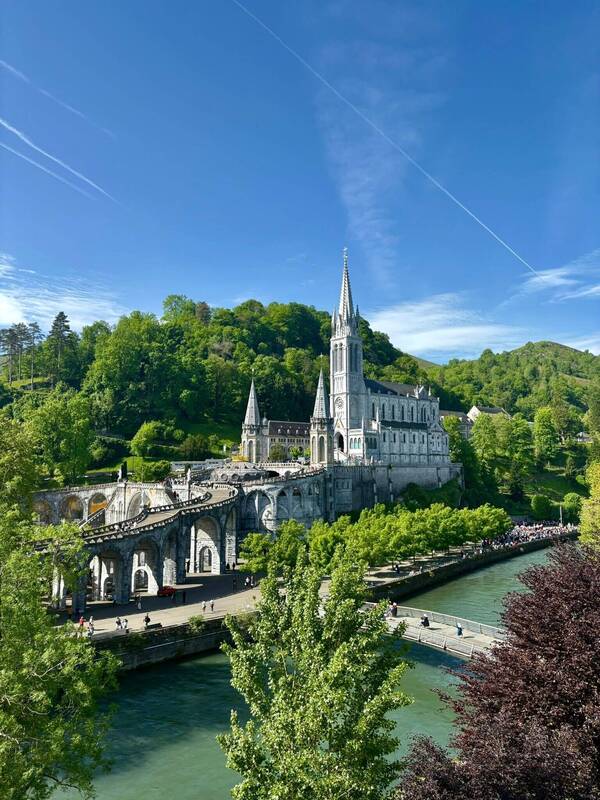
A church in Lourdes, France
One of the most impactful parts of my week was witnessing the manner by which ritual is capable of framing suffering and of creating communal space for hope. Whether through the nightly candlelit procession or the quiet reverence of the baths, I observed how structured liturgy helps give meaning to illness and allows for a kind of healing that transcends the biomedical. My time in Lourdes reinforced a notion which I had long believed: that healing often arises not from cure, but from presence. This experience is shaping how I think about clinical care as a future physician. It also affirmed my desire to study and practice medicine in a manner that honors both the physical and spiritual dimensions of health.
This experience allowed me to support individuals from around the world, many of whom arrived seeking physical or spiritual healing, and to witness firsthand the profound role of accompaniment in healthcare and faith. Working alongside both healthcare staff and fellow volunteers, I gained valuable experience in patient-centered service, cross-cultural interaction, and the integration of compassion into clinical care. It was this unique combination of medical, spiritual, and community dimensions at Lourdes which deepened my interest in medicine as a vocation of service and in turn reinforced my commitment to exploring healthcare through both scientific and humanistic lenses. Once again, this experience strengthened my resolve to value technical excellence in my future career without losing sight of the human, cultural, and spiritual dimensions of patient care.
My time at Lourdes was made possible by the Nanovic Institute, and I am deeply grateful for their support.
]]>
Notre Dame Newstag:nanovic.nd.edu,2005:News/1833442026-07-26T21:22:00-04:002026-07-26T21:22:24-04:00Small State, Big Principles: A Summer in Ireland’s Department of Foreign Affairs
By Ethan Chiang ‘27
Political science scholarship posits that small states engage in a paradigm of asymmetric normalcy with large states—often being overattentive to their interests in order to survive the international world order. While states may in fact choose to bandwagon with or balance against larger powers, Ireland—a small island nation in the European Union—has shown me how values-based diplomacy grounds their approach to foreign policy, irrespective of its comparative military and economic size.
In the summer of 2025, I had the privilege of interning with the Global Ireland and Economic Division (referred to as Globec) at Ireland’s Department of Foreign Affairs and Trade (DFAT). While it was the first year a Notre Dame student had interned with Globec specifically
, all my colleagues and supervisors were quick to warmly welcome me and integrate me into their team. Charged with expanding Ireland’s global influence and impact, these units promote Irish interests and values across various sectors of culture, economics, sports, diaspora, etc. The cross-sectoral and interdepartmental nature of their work allowed me to engage in a diverse range of projects over the course of the summer. From supporting projects on sports diplomacy, SXSW, market diversification, and mission reports to assisting with events like the Africa Ireland Trade Horizons Conference and National Day of Commemoration, I gained insight into the many arms of Ireland’s soft power and international engagements.
Working at the events, in particular, allowed me to connect with ambassadors and chargé d’affaires from nations around the world. As a student studying business analytics and global affairs, this experience allowed me to see my academic studies applied in a foreign service context. In further discerning a potential career in this field, it was enlightening to see the strategic foundation and work that underlies the public-facing diplomacy we often see in the media.
One of the focal points of my work was on sports diplomacy, as the Government of Ireland had recently approved a new International Sports Diplomacy Framework. Recognizing the unique power of sport in building connections across nations, this Framework sought to use sport to enhance intercultural understanding and advance Ireland’s foreign policy priorities and values abroad. In reviewing proposed projects from Ireland’s missions around the world, I was struck by the innovative ways in which sports diplomacy could be used not only to forge new partnerships but also to advance the common good through the promotion of human rights and sustainable development.
Notre Dame interns pose with Minister Timmy Dooley TD at the Ireland-US Council Dinner, held at Dublin Castle on June 27, 2025
This particular ability of diplomacy to bridge differences is salient in the current context of acute geopolitical fragmentation—wherein the underpinnings of even the most longstanding alliances are continually being tested. While this was not an explicit part of my work over the summer, it continued to be an ongoing point of conversation in the Department, as the US-Europe transatlantic relationship faced unprecedented strains and challenges. These conversations felt like a natural extension of many of the discussions I had in a “Deep Dive into Diplomacy” course I took with Professor Clemens Sedmak in the spring semester prior to arriving in Dublin. The class, sponsored through the Nanovic Institute’s Diplomacy Fellows program, involved a trip to notable fora of diplomacy and international law such as the International Criminal Court, NATO headquarters, European Parliament, and European External Action Service. I am deeply grateful for these collective experiences, allowing me to hold them in conversation and to see diplomacy in action on both a national and wider continental scale. For me, it has reinforced the importance of multilateralism, a commitment to the rule of law, democracy, and human rights at a time when these norms appear to be weakening in an environment of great power competition.
Ethan with his internship supervisors at a thank you celebration event hosted by Notre Dame Dublin at O'Connell House
This notion of “fracturing” was also the theme of the MacGill Summer School, which I attended at the conclusion of my internship with a group of fellow Notre Dame interns. This three-day conference convened government ministers, parliamentarians, heads of industry, economists, and other thought leaders to discuss critical issues facing Ireland, Europe, and the world. Situated against a backdrop of fracturing at the local and global level, this conference taught me a great deal about Ireland’s politics, economy, culture, history and Ireland’s particular position in the world.
When I ultimately reflect on the growth I experienced, I take note of everything from learning how to properly pronounce Taoiseach or Tánaiste (Ireland’s Prime Minister and Deputy Prime Minister, respectively) to the formative professional development from communicating with and working alongside my colleagues in an office environment. I hold a deepened appreciation and affinity for the day-to-day work of foreign ministries in supporting their countries’ international interests, whether on foreign policy issues or in cultivating relationships with another country. In a time when the face of diplomacy is dominated by political fallout or inflammatory accusations, my internship experience has reminded me that the work of the foreign service can be used to promote values that uphold human dignity and global cooperation.
On the penultimate day of my internship, my colleagues gifted me with an Ireland-Canada crossed flag pin and an Irish challenge coin, which a person is meant to show to others as a way of identifying their affiliation with the group. I now carry the flag pin with me on campus, and I look forward to the next time I can display my challenge coin on the Emerald Isle.
]]>
Notre Dame Newstag:nanovic.nd.edu,2005:News/1832742026-07-21T22:02:00-04:002026-07-27T11:44:46-04:00Preserving the Fabric of Faith through the PARISH Project
By: Matthew Scherber
In June and July 2025, I had the opportunity to make a small but meaningful contribution to a long-term research project which will enhance the breadth of available sources on the subject of Irish ecclesiastical and parochial history as well as democratize their use.
In recent decades, institutional challenges such as disaffiliation and demographic shifts have forced the Irish Catholic Church, once the most powerful and diffuse entity in the nation, to grapple with its identity and in very real ways to reimagine a material future which will look different from its past. All these changes have made the need to document and preserve the material heritage of the Irish Church all the more pressing because—as every new chapel is closed or sold off, the public loses access to valuable information written in the very fabric of its walls.
As a documentary photographer for the PARISH Project (Preserving And Recording Irish Sacred Heritage), I made my way across the Emerald Isle stopping at churches ranging from former horse stables converted into a sanctuary to major urban cathedrals. PARISH is a cooperative initiative of the Maynooth University Dept. of History and the University of Notre Dame’s Keough-Naughton Institute for Irish Studies to collect information and documentation on the history of the Catholic Church in Ireland, especially in the 19th and 20th centuries. It eventually hopes to catalog every Catholic place of worship on the island.
Much of the work relies on photographs and transcriptions of memorial and dedication inscriptions found in stonework and stained glass windows as well as carved into pew plaques in Irish churches. These inscriptions often contain important personal information useful to genealogists and social historians including, but not limited to birth, marriage and death dates, addresses, and the names of family relations.
I began my work in Maynooth, the small village an hour west of Dublin which served as my home base for my time in Ireland. From there I took buses from village to village, stopping in and photographing each local parish and chapel. Occasionally, there were obstacles to my research, mainly finding the keys to get buildings unlocked and navigating a nation efficiently on only public transit.
I explored the quaint neighborhoods of Galway and Cork and spent a lovely three nights with the Benedictine Sisters at scenic Kylemore Abbey, sleeping in the old servants' quarters above the chocolate kitchen. Meanwhile my more extreme efforts included hiking three hours up Croagh Patrick, a mountain in Northwestern Ireland, in a blasting gale to photograph the chapel at the top—a special chapel not often opened to visitors outside of the all-important weekend of Reek Sunday each July which commemorates St. Patrick's forty days of fasting on the peak.
It's safe to say forty days in that weather would be difficult for anyone to endure. My time in Ireland not only exposed me to the three to four dozen churches I had the honor of adding to the database but also to a wide swath of Irish history and culture. From the medieval castle just beyond the campus of St. Patrick’s College Maynooth to watching a show at Dublin’s Abbey Theater and a semifinal match in Gaelic Football at Croke Park, the rich heritage of the island was all around me. I had the chance to see how wild Irish lobsters are prepared when I stopped by the Ballymaloe Cookery School outside of Cork and to smell peat brick burning in the fire while I ate my breakfast near Adara in Donegal. A conversation with a session player in Matt Malloy’s Pub in Westport even inspired me to take up learning the banjo, an effort that is very much still a work in progress.
I am grateful to have had the chance to visit and pray in so many rural sanctuaries across Ireland, all of them unique testaments to the faith and devotion of generations of Irish families. Most of these were humble country churches built of stone and wood built up by local craftspeople in the years immediately following Catholic emancipation in Ireland in the mid-nineteenth century; even in the midst of harsh persecution, famine, and destitution the churches still went up. It was moving to see how communities had relocated shops from central squares to make way for the churches and how community members of all socio-economic backgrounds gave what they could to contribute to the building projects, even down to the cost of just one stone or brick for the walls. These buildings are truly at the heart of Irish patrimony, the collective heritage of the entire nation, and a central element of Ireland's cultural identity.
The PARISH Project has the potential to change how historians of Ireland, genealogists, and even artists and architects explore the rich Catholic heritage of the Irish people for decades to come, especially those among the Irish diaspora, like so many of us here at Notre Dame. It is an ambitious undertaking, one which will take many years to complete, but once finished will represent a dramatic leap forward in the digital infrastructure available to academics and amateurs alike for the exploration of Irish identity and devotional history.
I want to thank the Nanovic Institute for European Studies and the Keough-Naughton Institute for Irish Studies for their generous support of my research and their commitment to the study and preservation of the Catholic Church in Ireland. Without their support neither this project nor my participation in it would have been possible. It is my hope that in the coming years PARISH will continue to grow as an aid to researchers and hibernophiles everywhere as they explore the rich heritage of Ireland and her churches.
]]>
Notre Dame Newstag:nanovic.nd.edu,2005:News/1827212026-06-24T16:12:00-04:002026-06-25T00:10:20-04:00Tradition and Transformation: Digital Engagement and Catholic Parish Life in Contemporary Ireland
It is a Tuesday evening in Dublin and the city is awake. But inside Newman University Church, inconspicuously tucked among a row of buildings facing St. Stephen's Green, something quieter is happening. Upon entering, each visitor is handed a candle and invited into silence at Taizé, an ecumenical prayer service. A young woman moves through the pews with a lighter, and one by one small flames illuminate the sanctuary. Their glow reflects off a hand-painted cross beneath the altar. Then the music begins. Voices rise in meditative chant. People of all ages approach the cross, kneel, and pray. For a moment, the noise of modern life seems to disappear.
The Taizé service itself was not the subject of our research, but it captures many of the themes we hoped to explore through our project, Tradition and Transformation: Digital Engagement and Catholic Parish Life in Contemporary Ireland.
Before traveling to Dublin, we had become interested in the rise of Catholic engagement in digital spaces. From the growing popularity of the Hallow prayer app to the emergence of Catholic content creators, podcasts, and online communities, young adults seemed to be encountering faith in new ways. This led us to ask a central question: in an increasingly digital world, what role does digital communication actually play in bringing people into parish life, and arguably more importantly, what role does it play in keeping them there?
Jane and Anna on the side of the road in Ireland
As graduate students in Notre Dame's Master of Science in Digital Marketing program, we approached this question from both academic and personal interests.
We share a passion for digital communication and a deep appreciation for the history and culture of the Catholic Church. Jane's experience working at Newman University Church introduced us to a parish with a vibrant young adult community, a renowned music program, and a strong connection to Our Lady’s University. Combined with Ireland's complex history with Catholicism, Newman University Church offers an ideal setting to explore the intersection of digital communication and parish life.
With support from the Nanovic Institute for European Studies, we traveled to Dublin in the spring of 2026 to conduct focus groups following Sunday Masses, daily Masses, and the weekly Taizé ecumenical prayer service. We asked parishioners questions to understand how they first discovered Newman, what encouraged them to return, how the parish is different from other Churches they’ve encountered, and what role digital communication played in their experience.
What we found challenged many of our assumptions. Nearly half of respondents first learned about Newman through word of mouth, while many others simply walked through the church doors after passing by on St. Stephen's Green.
Data collected from focus group participants inquiring "How Did You First Hear About Newman University Church?"
Only a small percentage cited social media as their first point of contact. While digital communication was present, it was rarely the reason people initially engaged with the parish.
Instead, participants consistently pointed to the experience itself. They spoke about the beauty of the church, the quality of the music, the atmosphere of prayer, and the sense of community. One participant told us, "When I heard the choir, I felt I was in heaven. This is a heavenly place."
Data collected from focus group participants inquiring "What Keeps You Coming Back To Newman As Opposed To Other Churches?"
Another described returning to the Church after years away because they found a welcoming young adult community that made faith feel accessible again.
These findings led us to develop what we called the "Journey to Belonging," a framework describing how individuals move from first awareness of a parish to long-term participation. The journey consists of five stages: Awareness, Visit, Experience, Belonging, and Retention.
Digital communication plays an important but limited role within this journey. Social media, websites, and online content create awareness and provide information for those exploring a parish. Later, newsletters, WhatsApp groups, and email communication help sustain relationships and keep members informed between gatherings. However, the most important stages, experience and belonging, remain fundamentally human. They depend on personal face encounters, shared worship, and authentic community.
Visualization of the 5 steps to the Journey to Belonging supported with quotes from focus group participants
Our research suggests that digital communication does not create parish community; it extends it. Social media can introduce someone to a church, and a newsletter can encourage them to stay connected, but belonging is formed through relationships and lived experiences.
The role of digital communication is not to replace community but to support it—an important insight to fostering sustained, embodied participation in the Church amid a digital resurgence.
The scene described at the beginning of this article of Taizé offers a fitting illustration of this insight. Surrounded by candlelight and prayer, young adults gathered in the heart of a modern city to share an experience that could not be replicated through a screen.
Whatever brought them there—a friend's recommendation, a passing curiosity, or something encountered online—the reason they stayed was the religious experience itself.
By: Jane Porter and Anna O’Brien
]]>
Jane Portertag:nanovic.nd.edu,2005:News/1822212026-05-26T08:00:00-04:002026-06-01T16:07:52-04:00Statement from Rev. Robert A. Dowd, C.S.C., on the papal encyclical Magnifica humanitas
“In Magnifica humanitas, Pope Leo XIV has given us a profound gift: a teaching that reminds us that every human life possesses an inviolable dignity and that safeguarding this dignity must be the foundation of every decision we make as we develop and apply artificial intelligence.
“Signing this encyclical on the 135th anniversary of Rerum Novarum, Pope Leo XIII’s historic letter on the rights of workers, is a deliberate choice. Just as Leo XIII addressed the disorientation of the industrial revolution, Leo XIV calls us to moral clarity and solidarity in the midst of this latest societal transformation, underscoring the urgency of the questions humankind faces.
“At Notre Dame, our mission as a global Catholic research university compels us to advance Pope Leo XIV’s historic contribution to Catholic social tradition through our research, our teaching, and all of our work in service of the common good. The Holy Father has highlighted the critical role that Catholic scholars and researchers — and all those of goodwill — must play in raising moral questions and actively shaping new technologies to ensure they serve the entire human family.”
Rev. Robert A. Dowd, C.S.C. President, University of Notre Dame
Originally published by Notre Dame News at news.nd.edu on May 25, 2026.
]]>
Notre Dame Newstag:nanovic.nd.edu,2005:News/1822232026-05-26T08:00:00-04:002026-06-01T16:11:36-04:00Notre Dame experts respond to Pope Leo XIV’s encyclical Magnifica humanitas
On Monday (May 25), Pope Leo XIV released his first encyclical, Magnifica humanitas (Magnificent humanity), which provides moral guidance to bishops, clergy and the faithful on safeguarding the human person in the time of artificial intelligence (AI).
The encyclical was officially signed on May 15, the 135th anniversary of Pope Leo XIII’s encyclical responding to the industrial revolution, Rerum novarum.
Below, University of Notre Dame faculty experts from the College of Arts and Letters, College of Engineering, Keough School of Global Affairs and Law School offer their insights into the document.
Rev. Daniel Groody, C.S.C.
Rev. Daniel Groody, C.S.C., serves as vice president and associate provost for undergraduate education and professor of theology and global affairs. In addition to his role at Notre Dame, Father Groody is a member of the Vatican’s Dicastery for Promoting Integral Human Development and plays a key role in Notre Dame’s partnership with the Vatican’s Laudato Si’ Center on issues of integral ecology and global sustainability. His research focuses primarily on migration, theology, refugees and human displacement.
“Pope Leo’s Magnifica humanitas calls us to continually discern what it means to be human before God in a world increasingly shaped by artificial intelligence,” Father Groody said. “While this new digital age offers unprecedented possibilities for development, it simultaneously demands that we rediscover the true contours of our humanity. This authentic identity — rooted in an interior life, a moral conscience, human connections and a transcendent relationship to divine love — can never be quantified, modeled or replicated by machine learning. Against the technocratic impulse to reduce the human person to a mere data point, the encyclical boldly reasserts that we cannot be measured solely by technological acceleration but by holistic human development, human dignity and our commitment to the common good.
“Alongside new innovations, artificial intelligence reveals ancient temptations of radical self-sufficiency and idolatry. Warning against the modern temptation to construct a digital Tower of Babel in the pursuit of technological mastery, Pope Leo calls us instead to channel our energies into building the Kingdom of God and animating a ‘Civilization of Love.’ This sacred task requires an unwavering willingness to denounce the false forms of power that isolate us in algorithmic silos and blind us to our neighbors. In their place, Magnifica humanitas proposes a vision of life firmly anchored in justice, ultimately steering humanity toward the right ordering of our relationships with one another, with technology and with the Creator.”
Paolo Carozza
Notre Dame Law School professor, and Nanovic Institute for European Studies Faculty Fellow, Paolo Carozza is a member of the Pontifical Academy of Social Sciences and also the chair of the Meta Oversight Board. Both his research and policy work are focused on the intersection of Catholic social thought and technology, especially social media and AI.
“I am convinced that this will prove to be a defining document for our era, a profound and prophetic document,” Carozza said. “It is not just for Catholics, but speaks to the concerns of all of humanity.
“We are living in a time of daily dramatic transformations in every aspect of our lives because of AI, where the very understanding of what it means to be human is being called into question. This is coupled with a real vacuum of moral leadership on the global stage. In that context, Pope Leo is offering a clear, comprehensive and coherent voice urging us to take responsibility for constructing a world in which technology will serve humans rather than degrade them.
“From here on, I don’t think anyone will be able to speak meaningfully about the future of humanity in the age of AI without coming to terms with this document and taking it seriously. While it is very direct about the many dangers already arising out of algorithmic technologies, it is decidedly not an anti-technology document. The real question is not whether AI is good or bad, but whether the ways we develop and deploy the technology help individuals and communities become more humane, just and participatory, or whether instead they foster exclusion, control and inequality.
“The overarching core message is that if we are to preserve our humanity, we must not allow people to be reduced to mere data and commodities to be instrumentalized and exploited. It is a very hopeful document, not a doomsaying one. Pope Leo insists that moral progress here is possible, and the negative consequences of AI technologies are far from inevitable.”
Meghan Sullivan
Meghan Sullivan is the Wilsey Family College Professor of Philosophy and director of the Notre Dame Institute for Ethics and the Common Good. She leads a national research and public engagement initiative on AI and human dignity and meets regularly with tech leaders and AI developers in Silicon Valley. In March, Sullivan attended an Anthropic summit to discuss how to guide the moral development of the corporation’s chatbot, Claude.
“Magnifica humanitas is one of the most compelling and comprehensive treatments of AI ethics I have ever read — and I say that as someone who has spent the past few years immersed in this literature from both philosophical and policy perspectives,” Sullivan said. “Pope Leo XIV grounds AI ethics in the Church’s long-standing social doctrine, which has consistently offered a profound vision of human dignity.
“Christian tradition has never grounded human dignity in cognitive performance or economic productivity. It has never said: You matter because of what you can do. It says: You matter because of who you are. Someone with a body, mind and soul. Someone built for love. Someone with a mind oriented toward truth, accountable for our choices. We’re vulnerable in a way that these AI models are not. And Pope Leo argues that this special belovedness — made in God’s own image — makes us magnificent.
“What strikes me most is how practical this document is. It gives concrete guidance to corporate leaders, to policymakers, to educators, to everyday people navigating this technology. For those of us at Notre Dame, the pope’s charge to educational institutions is especially urgent. He argues that schools must resist the pressure to simply accelerate alongside the digital world and instead become irreplaceable centers of human formation — places where knowledge is integrated, where real relationships are built, where students discover the meaning of human dignity.
“This is exactly the work that Notre Dame’s DELTA network exists to do. With a generous $50.8 million grant from Lilly Endowment Inc., we are going to put this teaching on human dignity and AI into action — across K-12 schools, universities, churches and the public square. Today’s encyclical gives us both the theological framework and the moral insight we need. Notre Dame is ready to help the Church and the world answer Pope Leo’s call.”
Nitesh Chawla
Nitesh Chawla, an expert in artificial intelligence, data science and network science, is the Frank M. Freimann Professor of Computer Science and Engineering, director of the Lucy Family Institute for Data & Society and the Lucy Family Director for Data & AI Academic Strategy, leading the Notre Dame Data, AI and Computing Initiative. He uses advancements in AI, data science and network science to pursue common good through interdisciplinary research by collaborating with community and national partners.
“Magnifica humanitas makes clear that AI cannot be treated as morally neutral,” Chawla said. “Because these systems embody choices about what they measure, ignore and optimize and how they classify people and situations, they must be transparent, accountable and subject to meaningful evaluation.
“That is the work of Responsible, Inclusive, Safe and Empowering AI — RISE AI — at Notre Dame. Anchored in the Lucy Family Institute for Data & Society, RISE AI asks four practical questions: Who answers for an AI system across its lifecycle? Who is represented and served? Who is protected from harm? Who gains or loses agency? AI governance claims are only as good as the evidence chain that connects them to what the system does. RISE AI builds that chain. That chain runs through audit logs, red-teaming, subgroup performance, accessibility, redress and user-agency measures that show what a system actually does and where its limits are.
“The encyclical’s most important insistence is that moral and technical questions cannot be separated; they meet in how systems are evaluated, audited, deployed, made contestable and governed. As paragraph 109 puts it, social justice must ‘shape the very design’ of these systems from the outset, not be retrofitted after deployment. That means building AI that is not only powerful but legible, accountable and directed toward integral human development and the common good — making responsibility measurable, inclusion visible, safety testable and empowerment real.
“As Magnifica humanitas insists, responsibility must be ‘clearly defined at every stage.’”
Kathleen Sprows Cummings
Kathleen Sprows Cummings is a professor of American studies and history and director of the Global Catholic Research Initiative. A papal analyst for NBC/MSNBC, she offered expert commentary during the 2014 canonization of Popes John Paul II and John XXIII, Pope Francis’ U.S. visit in 2015, Pope Francis’ funeral in 2025 and the conclave that elected Pope Leo XIV.
“‘Age gives way to age,’ wrote Pope Leo XIII in Rerum novarum, ‘but the events of one century are wonderfully like those of another, for they are directed by the Providence of God.’ In Magnifica humanitas, an encyclical dated exactly 135 years after Rerum novarum, Pope Leo XIV also invokes God’s invisible work in history,” Cummings said. “And, like his namesake, he considers the central challenge of the age — in this case, the advent of artificial intelligence — in light of the Church’s timeless principles.
“More humble in tone than Rerum novarum, Magnifica humanitas is a far more capacious document that operates on several levels at once: an explanation of Catholic social teaching as it has developed since Rerum novarum; an affirmation of the intrinsic, God-given value of each person, which is not tied to what they achieve or produce; a rumination on the wonder and limitations of being human; a meditation on history, including an unflinching acknowledgement of the Church’s complicity in its darker moments; and an invitation to individuals and institutions to think creatively and collaboratively about how to ‘disarm’ new technologies and harness them for good.
“In his powerful conclusion, Pope Leo entrusts this endeavor to Mary, quoting from the Magnificat, her revolutionary ‘song of hope’ which glorifies the God who delivers the humble and oppressed, dislodges the privileged from their positions of power, and continues to make all things new in this and in every age. In that sense, Magnifica humanitas ultimately offers consolation to a world in desperate need of it.”
Arun Agrawal
Arun Agrawal, the Pulte Family Professor of Development Policy and director of the Just Transformations to Sustainability Initiative, studies environmental politics, sustainable development and transformative change. He has spent time with Catholic leaders discussing ways to care for our common home globally and across all disciplines and can address how AI technology is impacting the environment.
“The words ‘common good’ appear in Pope Leo’s encyclical, Magnifica humanitas, more often than the words ‘artificial intelligence’ or ‘AI,’ more often than ‘church,’ and more often than ‘religion,’” Agrawal said. “In its mention of the common good, the encyclical resonates with Pope Francis’ call for care for our common home. This continuity and this focus on the common — on the community of which we are all a part — is a characteristic feature of what it means to be human, to be part of the interconnectedness of all creation.
“Fundamentally, the encyclical is a call to heed and act for the common good. It is a call to move away from the kind of politics that advances only the fortune and interests of a select few. Increasingly, our politics pushes to the side the grandeur of humanity and promotes markets that profit the elite instead of supporting the common good.
“It prophetically recognizes that the ‘invisible hand’ of the market is in fact about the visible hand of politics that helps the marriage of finance and technology. It instead asks for our politics that would direct technology and finance and artificial intelligence to support the common good so as to achieve the grandeur of humanity. It is only by attending to this call that we have any hope of maintaining the dignity of the whole person.”
Contact: Carrie Gates, associate director of media relations, 574-993-9220, c.gates@nd.edu
Originally published by Notre Dame News at news.nd.edu on May 25, 2026.
]]>
Notre Dame Newstag:nanovic.nd.edu,2005:News/1819412026-05-18T16:38:00-04:002026-05-20T16:39:32-04:00Research, fellowship, and faith abound at the Notre Dame-Ukrainian Catholic University Impact Forum
Where can hope be found in wartime? In small victories, certainly. But also in the belief of something bigger, in the hope that peace will prevail. Institutions like the University of Notre Dame and Ukrainian Catholic University would call that faith.
For 22 years, Notre Dame has sustained a partnership with Ukrainian Catholic University (UCU), rooted in a shared Catholic identity. That partnership expanded in 2022 after the full-scale Russian invasion of Ukraine, when Notre Dame added new programs and funding for research grants. Sixteen grants, funded by Notre Dame Global and Notre Dame Research, have been awarded since 2022 to ND and UCU faculty to pursue joint research on concerns central to Ukraine.
Additionally, in 2023, the Nanovic Institute launched the Ukrainian Studies Hub—a University-wide initiative that brings together scholars and students focused on Ukraine. The Hub leads education and research initiatives and serves as a platform for building partnerships in Ukraine and responding to the critical challenges facing Ukrainians and the global community. It brings to life Notre Dame’s work as a founding member of the Global Coalition of Ukrainian Studies, and, in partnership with UCU, also hosts a biennial conference at Notre Dame.
The vitality and continued growth of this university partnership were evident at the recent gathering of the Notre Dame and UCU community in Washington, D.C. Over 100 people came together for The Ukraine Impact Forum: Faith & Resilience. The forum took place at Notre Dame’s Washington Office, providing a vital nonpartisan venue for US and Ukrainian leaders to engage, and was co-organized by Notre Dame Global, the Keough School of Global Affairs, the Nanovic Institute for European Studies, Notre Dame Research, and Ukrainian Catholic University. It brought together faculty and staff from both institutions, civic activists, partners, politicians, and Notre Dame alumni. The goal of the forum was not only to present on joint research projects, but also “to impact policy and future research, start conversations, and engage colleagues and partners around the world,” as Michael Pippenger, Notre Dame’s vice president & associate provost for internationalization, shared in his opening remarks.
Ambassador Olha Stefanishyna
Other key speakers included Ambassador Olha Stefanishyna, Ukraine’s Ambassador to the United States; Archbishop Borys Gudziak, Metropolitan-Archbishop of the Ukrainian Catholic Archeparchy of Philadelphia and UCU president; Taras Dobko, UCU rector; Yaroslav Prytula, UCU senior vice-rector and provost; Sophia Opatska, UCU vice-rector of strategic development; Jeffrey Rhoads, John and Catherine Martin Vice President for Research at Notre Dame; and Mary Gallagher, dean of Notre Dame’s Keough School of Global Affairs. The forum was also honored to welcome senior government officials, including Naz Durakoğlu, Staff Director, Senate Foreign Relations Committee.
Throughout the course of the day’s events—filled with fireside chats, talks, and presentations—a clear thread emerged. This was a partnership grounded in faith and energized by putting that faith into action.
During her remarks, Ambassador Stefanishyna spoke to the importance of not just academic diplomacy but faith diplomacy: “In times of uncertainty, faith remains the only ground which keeps us united.” She also discussed universities’ role in conflicts, stating that the shared objective of universities is to “translate research into politics and insights into action.” She noted how universities in Ukraine, such as UCU, are turning their experience of crisis into actionable knowledge—exemplified through Ukraine becoming more technologically advanced due to the war.
When asked during his conversation with Dean Gallagher what Catholic universities specifically can do in the midst of conflict, Archbishop Gudziak answered, “Do what we do, but do it heart to heart.” Catholic universities are as well-positioned as other universities to provide partnership, research, and resources to those in need. But a Catholic foundation allows institutions to go one step further, emphasizing “integral human development.” This holistic approach recognizes that lasting recovery depends on the development of the whole person, and that researchers at ND and UCU consider data in the context of the human lives and communities it represents.
Michael Pippenger and Taras Dobko
During the fireside chat between Pippenger and Dobko, the two discussed what it means to serve at faith-based institutions in a secular society. “I think faith-based institutions are particularly capable, and they have a mission to increase the number of dedicated and passionate people,” Dobko said. Reflecting on UCU’s role in the current crisis, he shared that “UCU should be a source of hope and a source of unity for the Ukrainian people.” For UCU, putting their faith into action means cultivating hope not just among their students and on their campus, but also putting scholarship, research, and science into action to improve the lives and resilience of the Ukrainian people as a whole.
Pippenger remarked on how Notre Dame has learned from UCU’s ability to reinvent the university to meet the needs of a society under duress, to which Dobko emphasized that universities should be communities that not only teach but also learn. “This learning experience comes from responding to the present,” he says. One of the ways Notre Dame and UCU are fostering hope and reacting to the current situation is through research. As Pippenger shared, “We are being led by our hearts, we’re being led by our faith, but it allows us to do practical work that will be transformative in the secular world.”
Some of that practical work was presented at the forum, where faculty teams—each pairing a Notre Dame faculty member with an UCU colleague—presented updates on their ongoing research projects that involved a diverse set of themes and disciplines related to the ongoing conflict, including collective trauma and healing, ethical infrastructure and moral dimensions of security, data science for the common good, and the role of religious diplomacy in the ongoing war. These projects showcased how collaborative scholarship can be a profound form of solidarity and how the synergy between the spiritual and the empirical served as the forum’s true North Star. By presenting rigorous, policy-relevant findings on the ethical infrastructure of reconstruction alongside the data-driven strategies for human resilience, the ND-UCU researchers demonstrated that faith and scholarship are not at odds; they are the dual engines of Ukraine’s resistance, recovery, and reconstruction. One provides the ‘why’—the inherent dignity and moral security of the person—while the other provides the ‘how’—the technical expertise needed to rebuild a sovereign, flourishing society.
This resilience is forged in profound sacrifice; as noted during the forum, the UCU community has already lost 38 of its students, alumni, faculty, and staff to Russian attacks—lives that the partnership seeks to honor through its commitment to a free and flourishing Ukraine. Behind each name is a “whole person”—a world of unique talents, deep family bonds, and vocations cut short.
Dean Mary Gallagher and Archbishop Borys Gudziak
In offering closing remarks, Clemens Sedmak, director of the Nanovic Institute for European Studies and professor of social ethics at the Keough School, emphasized that research projects like these give people reasons to care and overcome the temptation to indifference in the face of great conflict. “Why should you care?” he asked. “Because people are precious, the stakes are high, and the injustice is grave.”
The participants’ presence at this forum was proof that they understood the imperative, but the work is far from over. As Dean Gallagher reflected on the closing remarks, she asked Archbishop Gudziak whether he had a call to action to offer the group as they considered their own commitments in response to the sessions. He shared three: “Pray, because we've seen too many miracles not to understand that God intervenes in history. Second, advocate, inform, be informed, and inform others. And third, help as you can, everybody according to their talents and their means.”
At the end of the day’s talks, Sedmak asked Archbishop Gudziak to lead the group in a closing prayer before the reception. Archbishop Gudziak approached the mic and, instead of leading the group in a typical spiritual reflection, he invited those present to join in prayerful song in Ukrainian. Within seconds, his voice was joined by the Ukrainian members of the gathering. Reflecting on this moment, Pippenger mentioned, "There was a palpable sense of unity in the room. The participants of the Notre Dame and UCU community were united by their faith, by a commitment to preserving the cultural identity resonating throughout the room, and by a shared desire for the common good of one another."
Originally published by Jessie Carson at global.nd.edu on May 18, 2026.
]]>
Jessie Carsontag:nanovic.nd.edu,2005:News/1815622026-05-11T13:52:00-04:002026-05-20T16:37:26-04:002025/2026 Undergraduate Research Conference Awards
On March 27, 2026, the Nanovic Institute for European Studies hosted the third Undergraduate Research Conference in European Studies. This event, organized around three unique panels throughout the day, allowed students studying Europe to share their research with peers and the Notre Dame community, including faculty moderators. These panel topics included “Europe Confronts the Refugee Challenge,” “Art and Identity in Contemporary Europe,” and “Belonging and Exclusion at Europe’s Peripheries.”
Today, the institute announces the prize winners from the conference. Student presentations throughout the day were evaluated, and two students were recognized with gold and silver awards.
Gold Award: Abby O’Connor ’26
Abby O'Connor: Gold Award Winner
Abby O'Connor received the gold award for her paper and presentation: “The Flight of Picasso’s ‘Guernica’: Spain’s Transition to Democracy, Historical Memory, and Integration into the European Community.”
Originally from Toledo, Ohio, Abby is a senior majoring in Art History and Anthropology with a European Studies minor. She has contributed to two Nanovic Institute Research Projects, Fighting for Democracy and Human Rights through the Arts and Sites of Memory in Contemporary Europe, the former involving research in Spain. Abby is currently writing an Honors Art History Senior Thesis focused on contemporary Spanish Basque site-specific sculpture's engagement with local politics, regional identity, and ecology. Beyond her research, she has worked as a student tutor and served as the president of the Art History Club and secretary of FeministND.
Silver Award: Ignatius Caro ’29
Ignatius Caro: Silver Award Winner
Ignatius Caro received a silver award for his paper and presentation: “Warsaw and the World: An Ethnographic Analysis of the Globalized Stage of the International Chopin Piano Competition.”
Ignatius Caro is a first-year student studying Chemistry and Piano Performance. He is currently studying catalysis by characterizing novel organometallic structures and reactions while also exploring the various ways in which classical music manifests itself in contemporary Europe and the world. This October, he traveled to Warsaw on his first-ever international flight to research how the global perspectives of the audience and the competitors intersect on the stage of the world's oldest and largest piano competition. He extends his thanks to the Nanovic Institute for European Studies, the Glynn Family Honors Program, and the Notre Dame Arts Initiative for their generous support of his fine arts research.
While these two students are officially recognized, the Nanovic Institute offers its sincere congratulations to all the students who participated. We thank all the students for participating and hope it was an impactful part of your Notre Dame journey.
We also look forward to next year's conference. If you are doing research in or about Europe over the next year, watch for a call for proposals or contact Dr. Roy Kimmey, senior program manager for student research and academic affairs at the Nanovic Institute.
]]>
Mia Simmonstag:nanovic.nd.edu,2005:News/1816282026-05-05T09:22:00-04:002026-05-12T09:26:23-04:00Historian Katlyn Carter wins Andrew Carnegie Fellowship for research on truth in early American politicsKatlyn Carter, associate professor of history
Carter, an associate professor in the Department of History and faculty fellow of the Nanovic Institute for European Studies, was one of 24 scholars and writers from a record 381 nominees to receive the honor. The fellowship includes a two-year grant of up to $200,000 to support research for her second book, “The Politics of Truth in Early America,” and to develop an undergraduate course aimed at the fellowship’s theme of understanding and addressing political polarization in the United States. The stipend is among the most generous of its kind, and previous Carnegie fellows have received numerous honors for their research, such as the Nobel Prize and National Book Award.
“Concern about the declining importance of truth in American politics is a crisis that can feel new to us, but Katlyn’s scholarship is a reminder that this phenomenon has existed since the founding of our country,” said Kenneth Scheve, the I.A. O’Shaughnessy Dean of the College of Arts & Letters and a professor of political science. “I’m thrilled that the Carnegie Corporation is supporting her vital research on this topic, which will provide a much-needed historical lens to a question that is so fundamental to contemporary social and political life.”
A historian of 18th-century America and France, Carter explores research topics inspired by issues that feel intractable in our politics today, she said.
In her first book, “Democracy in Darkness: Secrecy and Transparency in the Age of Revolutions,” Carter explored how decisions and debates about the place of secrecy in politics during early American and French revolutionary history shaped representative democracy and addressed the realities of what it meant to make government transparent in practice.
Through that project, Carter began developing questions about the origins of truth and trust as they related to the press and government — specifically in the United States.
“It’s one thing to say this group of people met in secret and talked about this, and that became a flash point. It’s another thing for people to say, ‘those people are lying to you, and I’m telling you the truth,’” Carter said. “And I just started getting really interested in tracing that in early American political debates and rhetoric.”
In “The Politics of Truth in Early America,” Carter will examine those large topics of truth, trust, communication technology and politics in early American history by exploring digital archives and traveling to historic research centers and libraries in Philadelphia, Boston, New York City, London, Paris and Washington, D.C.
She will also take the time to develop a course tentatively titled The Politics of Truth: A History, which will aim to “historicize some of the tough questions that we’re wrestling with today about truth and politics.”
“I want to try to take those challenges and try to break students out of this rigid political binary that we’re in right now by taking these difficult questions and translating them to history,” Carter said. “I just don’t think we can understand these challenges without understanding the history of those problems, of the political system we live in or of the way people have thought about these questions in the past.”
The Carnegie Fellowship class of 2026 is the third cohort focused on developing a body of rigorous, evidence-based research about what can be done to strengthen the forces of cohesion in the United States, an overarching priority for the foundation’s grant-making. The 2026 class also includes Notre Dame alumnus Wayde Marsh, who received a Ph.D. in political science in 2022 and is now an assistant professor of political science at the University of Tennessee, Knoxville.
“There was a team of people at Notre Dame who are really skilled at what they’re doing and who really helped me deliver the message clearly and connect to the theme of the fellowship,” Carter said. “Important research and scholarship that connects with people and helps inform and work on current challenges takes time. This fellowship actually gives researchers time to read and think, which is increasingly rare in a society that really likes to push for efficiency and going fast. That’s really valuable.”
Originally published by Mary Kinney at news.nd.edu on May 05, 2026.